
Earlier in 2026, India marked one of its biggest technological milestones by announcing a strategic partnership between Tata Electronics and ASML, the Netherlands-based global leader in semiconductor lithography systems. The collaboration supports the development of Tata Electronics' semiconductor fabrication (fab) facility in Dholera, Gujarat, a project valued at approximately $11 billion.
While the announcement already made headlines across the technology industry, the partnership is about much more than building a semiconductor factory. It reflects India's ambition to become a trusted player in the global semiconductor supply chain, strengthen domestic manufacturing, and reduce dependence on imported chips.
At a time when chips sit at the center of digital infrastructure, industrial automation and advanced manufacturing, this collaboration represents a long-term investment in India's technological future, manufacturing capabilities and innovation ecosystem.
What Is a Semiconductor?
A semiconductor is a material that can transmit electricity under certain conditions; thus, it is the main component of any electrical device. The most popular semiconductor in the world is silicon, which provides optimal performance, stability, and low cost.
The semiconductor chip or integrated circuit (IC) consists of many transistors manufactured on a thin slice of silicon. The transistors perform calculations, memory management, and control of electrical processes.
Nowadays, semiconductor chips are applied in practically all industries, such as:
- Smart phones and tablets
- Laptops and desktops
- Artificial intelligence (AI) systems
- Electric and self-driving cars
- Smart televisions and smart home appliances
- Automation and robotics systems
- Medical equipment
- Telecommunications and 5G technology
- Aerospace and defense equipment
In simple terms, without semiconductor chips, there wouldn’t be any modern digital world at all.
Why Are Semiconductors More Important Than Ever?
Over the past decade, the demand for semiconductors has never been seen to grow faster than in recent times. No matter what technological development it is, be it artificial intelligence (AI), electric cars, cloud computing, smart factories, or the internet of things (IoT), everything needs to have chips that are efficient and highly reliable.
The shortage of chips faced by the world during the pandemic outbreak brought into light the vulnerability of global supply chains. The problem was due to the fact that the chip-making industry had become concentrated into some regions only.
Many countries have decided to invest in the manufacture of semiconductors within their nations to overcome future challenges and promote national security.
India is also now taking a significant step to do the same.
Understanding ASML: The Company Behind Advanced Chip Manufacturing
Headquartered in the Netherlands, ASML is the world's leading manufacturer of photolithography systems; the highly sophisticated machines used to manufacture semiconductor chips. These machines project extremely precise circuit patterns onto silicon wafers, enabling manufacturers to produce modern processors and electronic components.
ASML's technology is considered a tech marvel to the global semiconductor industry. Its portfolio includes Deep Ultraviolet (DUV) and Extreme Ultraviolet (EUV) lithography systems, some of the most advanced manufacturing technologies ever built.
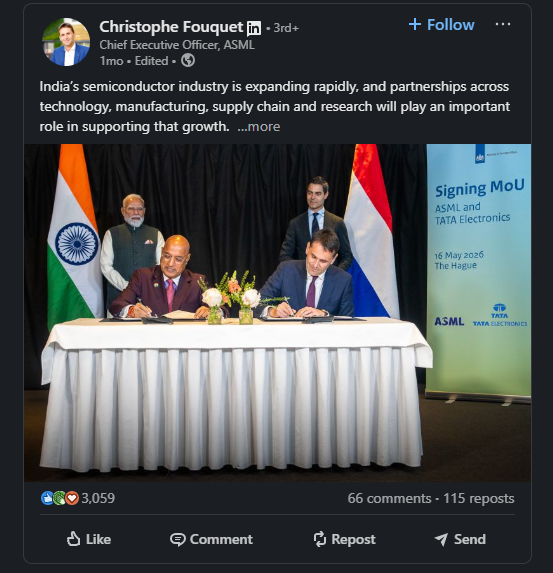
Christophe Fouquet, President and CEO of ASML, described the partnership as another important step toward supporting India's semiconductor ambitions, emphasizing the company's commitment to working closely with Tata Electronics to turn this vision into reality.
Because designing these machines is so phenomenally difficult, only a tiny handful of companies globally have the expertise to manufacture it, making ASML one of the most strategically important and irreplaceable players in the entire global tech landscape in the semiconductor ecosystem.
Tata Electronics and India's Semiconductor Vision
As part of the Government of India's semiconductor mission, Tata Electronics is developing the country's first commercial 300 mm semiconductor fabrication facility in Dholera, Gujarat.
Announced in May 2026, the project represents an investment of approximately $11 billion and is expected to manufacture semiconductor chips used across automotive, industrial electronics, consumer devices, telecommunications, computing and AI-enabled technologies.
Unlike software development, semiconductor fabrication involves hundreds of highly precise manufacturing processes carried out inside ultra-clean production environments known as fabrication plants or "fabs." These facilities are among the most advanced and expensive manufacturing infrastructures in the world.
The Dholera fab is expected to focus on mature-node semiconductor technologies, primarily in the 28nm to 110nm range. While these are not the latest cutting-edge process nodes used for flagship AI processors or premium smartphones, they remain essential for a vast range of real-world applications.
Why Isn't India Starting with 2nm Chips?
One question frequently asked after the announcement was:
"If companies like TSMC and Samsung are already producing 2nm chips, why is India starting with 28nm to 110nm?"
The answer lies in understanding the needs of the global electronics industry.
Not every electronic device requires the world's smallest or most advanced semiconductor. In fact, mature-node chips continue to power a significant portion of products used every day, including modern technologies.
Think of it this way: not every vehicle on the road is a Formula One car or a Ferrari. Trucks, buses, SUVs and family cars are equally important because they keep economies moving every day.
The semiconductor industry works in much the same way. While advanced 2nm chips power cutting-edge AI systems and flagship smartphones, mature-node chips form the backbone of countless industries worldwide. They offer proven reliability, lower production costs and are ideal for large-scale manufacturing.
This is precisely why India's initial focus on mature-node semiconductor manufacturing is a strategic and commercially practical decision rather than a technological limitation.
Understanding the ASML–Tata Electronics Partnership
Unlike the mere provision of manufacturing equipment, the strategic alliance of Tata Electronics and ASML is much more broader.
According to the agreement, ASML is expected to offer state-of-the-art lithography machines, manufacturing skills, technical assistance, workforce training, and knowledge transfer services for the development of Dholera semiconductor fabrication facility.
For Tata Electronics, this partnership provides access to one of the most reliable technology partners in semiconductors. On the side for ASML, it gives an opportunity to participate in the development of the burgeoning semiconductor industry in India.
As CEO and Managing Director of Tata Electronics, Dr. Randhir Thakur said, the partnership will help ensure the successful ramp-up of the Dholera fab while strengthening India's semiconductor supply chain, driving innovation, developing local talent, and building manufacturing excellence.
More importantly, this collaboration is not just about producing chips — it's about creating an ECOSYSTEM capable of supporting India's long-term ambitions in advanced manufacturing and technology.
Conclusion
The last six months of 2026 have been quietly witnessing one of the most important transformations of the industrial story of India. The ASML-Tata Electronics partnership might not continue making the headlines forever, but the ecosystem that they are building, which consists of well-trained engineers, robust supply chain management systems, and an assured manufacturing base, will pay off for decades to come.
India was not in the race to manufacture semiconductors at the finish line. It joined where the real work and real opportunities actually is and matters.
And this is just the only beginning.
In the second part of the series, we will explore more about the meaning of this partnership to India's ecosystem of semiconductors, the future challenges, global ramifications, and how this could change India's position in advanced manufacturing. Stay turned for more.
Read 2: Beyond the Fab: What the ASML–Tata Partnership Means for India’s Semiconductor Future