
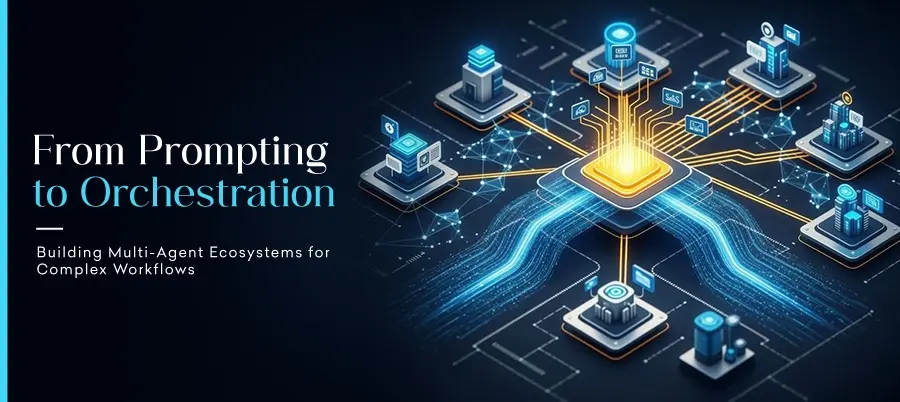
One year ago, "using AI" meant typing a prompt into a chat interface and receiving one output. Today, imagine a scenario where a research assistant agent collects recent market statistics, gives it to an analyst agent to create a financial model, which will then give its insights to a writer agent to create a report and a reviewer agent will make sure the report does not contain any errors even before it lands in your email inbox. None of this is a result of a single prompt; instead, it is the outcome of an efficient operation of a whole team of AI agents that work together.
The development of such ecosystems from simple-shot prompting to full multi-agent orchestration is becoming one of the key trends in using AI within businesses today. It is not just about asking smarter formulation questions but creating an AI workers' ecosystem that knows how to work together. Let us take a closer look at what it really means.
Multi-Agent Orchestration - What Is It All About?
At its simplest, multi-agent orchestration involves coordination of multiple numbers of AI agents that have their unique roles, toolset or specialization to accomplish some kind of complicated task that would not be possible for an individual agent.
Just imagine the maintenance team of a hospital. Of course, you do not expect a person to deal with equipment breakdowns, spare parts procurement, preventive maintenance and documentation. But, hospitals use coordinated approach to achieve their objectives:
There is a triage step that determines which tasks require immediate attention - equipment malfunction or lighting fixture replacement?
There is dispatching of a respective technician or engineer for performing certain tasks.
There is tracking what has been done and what needs to be done.
This is, in essence, how the "Maintera" platform works in reality by giving shape to maintenance processes through work orders management, allocation of technicians and preventive maintenance scheduling without leaving anything up in the air. Maintera does not perform each task directly but coordinates all actions to be done, their timing and the order in which they have to be performed. This, once again, is exactly what current multi-agent AI systems are based on.
From the point of view of artificial intelligence, this coordination activity is referred to as the orchestrator agent function. The orchestrator agent decomposes the whole goal into smaller sub-goals and then assigns these sub-goals to specialized agents ("workers") that perform particular tasks. Afterwards, the orchestration agent integrates the outcome of their work in a consistent result. Some architectures employ a hierarchical structure (one orchestrator, many workers), while some use peer-to-peer one.
A Real-Life Team Example (Because This Isn't Just an AI Thing)
Even without the concept of AI ever being introduced, humans knew how to achieve this already. Think about an agile team responsible for rolling out a new product feature in four weeks at a mid-size company.
First of all, the project lead would break down the whole process into parts (design, development, quality assurance and marketing) rather than handling everything by themselves.
- Designers work independently on mockups and the development simultaneously spins up the backend of the feature without having to wait for each other.
- QA testers won't wait until the last minute but will be testing the feature module by module as they get completed.
- Marketing starts preparing content and designs based on the early drafts.
- Project lead again puts everything together in the last week and makes sure that everything is aligned before the launch.
No one on that team performed all tasks. Each one had their own area of focus, operated in parallel wherever possible and reported to the coordinating position. This is the exact same principle upon which the multi-agent AI orchestration is built. You just have to substitute "team members" for "agents" and "project lead" for "orchestrator agent."
Why This Matters Now
Prompting using a single AI is limited by its scope and capabilities very quickly. If you ask one general-purpose AI to search for information, write a piece of code, execute this code and prepare the whole report in the best possible way, then most likely you will be disappointed by its performance — as if you asked one employee to play several roles.
The multi-agent solution allows solving this issue through specialization and dividing of labor. This principle has been used in human societies for centuries to increase efficiency. Here are just some of the reasons why this approach gains popularity so quickly:
- Increased accuracy — each agent executes a more specific task (searching, programming, reviewing, summarization) providing more accurate results than a single general-purpose AI.
- Parallel processing — independent tasks can be performed in parallel, rather than in one long chain.
- Error correction — one dedicated agent reviews or verifies the results before they are given to a human just like in the case of quality assurance process.
Industry reports of enterprise AI adoption emphasize orchestration and agentic workflows as one of the key focus areas for the year 2025 and 2026.
Real-Life Use-Cases
1. Software Development pipelines A planner agent parses the user story or feature into smaller tasks. A coder agent implements the software. A tester agent creates and executes test cases. A reviewer agent reviews the coding for style and security problems before any human even sees the pull request. More and more engineering teams adopt this approach in order to get things done in hours that would take days before.
2. Customer Support Escalation A generalist agent resolves routine support tickets. Whenever it spots a billing issue or bug which is not in its expertise, it escalates the conversation to a specific agent or a human along with all relevant information provided.
3. Financial Research and Reports Generation Investment firms employ a pipeline where data gathering agents, models building agents and compliance checking agents collaborate to prepare reports and research much faster, while an auditor agent validates computations and identifies anomalies.
4. Marketing Content and Operations Research agents compile trending topics, writers produce content, SEO agents optimize keyword usage and editing agents ensure consistency with brand voice all prior to a human marketer’s final review.
5. Enterprise Knowledge Management Large enterprises utilize retrieval agents for information gathering from internal documentation, reasoning agents to synthesize answers and verification agents to verify facts against internal documents to prevent hallucinations in their enterprise Q&A applications.
Problems Nobody Wants To Talk About
Multiagent systems aren’t a magic solution to anything and a few recurring problems always crop up in real world implementations:
- Coordination overhead – the more agents there are, the more communication is involved and the chance of miscommunication between agents (one agent getting the message wrong) can make the problem worse rather than better.
- Costs and latency – using five agents instead of one model leads to increased costs, not to mention slower response time if done inefficiently.
- Debugging difficulties – if there’s an error in the system, diagnosing the root cause becomes harder when it’s passed around by multiple agents.
- Trust and control – as the agents become capable of interacting with other systems, accessing data and performing actions on their own, human oversight becomes absolutely necessary.
The teams that work successfully with orchestration systems typically start small: one well-defined task with 2 or 3 agents, built-in debugging and logging right from the start, expansion of the system only after proving the concept.
Frequently Asked Questions (FAQs):
Is multi-agent orchestration the same thing as a chatbot that uses plugins?
Not necessarily. Plugins are usually extensions to one model inside one conversation. Multi-agent orchestration consists of multiple separate agents, which could have a separate memory and decision-making processes.
Do I need to use different AI models for multi-agent orchestration, or is it possible to use one model to play different agent roles?
Both options are fine. Many applications use the same base model but prompt it with different prompts, tools and permissions to play different "roles," while some applications use different models that are better at different things. Eg., coding vs. writing.
Can multi-agent orchestration be only used by large companies?
Not necessarily. Even small groups of people working on content automation, research or customer support will be able to use this method with just a few agents.
What is the primary risk associated with multi-agent systems?
It's compounding errors; when one of your agents makes a mistake, other agents further down the line will take advantage of it. This means that verification procedures should be very tight.
Where do I begin?
Start with a single workflow first and don't try to automate an entire department. Bring agents onboard one by one and spend some time setting up logging so you can monitor the agents and their actions closely.
Conclusion
The shift from prompting to orchestration reflects a true paradigm shift in the application of AI in practice. It is the distinction between employing a talented generalist who does everything and building a team where everybody is aware of their roles, efficiently delegates responsibilities and cross-checks each other's mistakes. No matter whether it is a team responsible for the launch of the new product and sharing their tasks according to their strengths, Maintera platform managing the schedule and collaboration of the technicians in a facility, or multiagent system where AI agents delegate responsibilities to each other, the basic principle remains the same – complex tasks get completed more effectively when they are delegated, controlled and coordinated. Of course, coordination, costs and control still pose serious difficulties. Nevertheless, for organizations dealing with truly complex multi-stage processes, a multiagent ecosystem becomes an inevitability rather than some distant future.