15 Jun The Death of the Click: Marketing in a Zero-Click World
Somewhere, along the way, there has been an alteration in how people search online — and marketers aren’t really aware of it.
It hasn’t happened overnight. There was no press release announcing a shift in consumer behavior, nor any email from Google saying that things have changed for good. The shift has been gradually happening for years and only now, in 2026, has it reached critical mass.
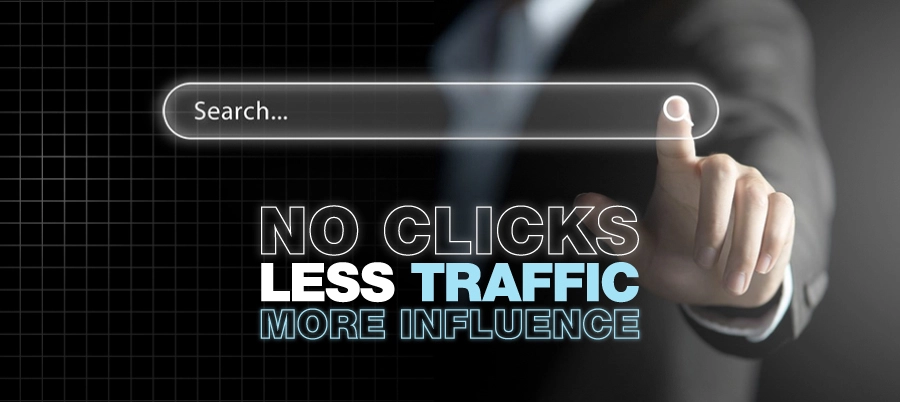
People still search. They just don’t click anymore.
This, however, makes this particular point in time one of the most fascinating times in the world means — this is one of the most interesting moments in digital marketing history to be paying attention.
What does the Zero-Click Search concept actually mean ?
The definition of zero-click search is a Google query which returns no clicks at all, as the user finds the information they sought within the results page itself – either inside the AI Overview, a featured snippet, a knowledge graph, or a direct answer box. In other words, the user does not need to click on any links in order to get what they are looking for.
This used to be pretty much a non-issue some time back. If someone asked Google, “In what year did the Eiffel Tower get built?” Google would give them 1889, and the query would close right there. This did not hurt anybody in any way.
But nowadays the zero-click behavior has expanded into areas of actual commercial interest. Queries related to product comparisons, software recommendations, marketing strategies, best practices in any field whatsoever – these are all things which content creators worked hard to target for years.
Recognizing this trend calmly and rationally without panic is the first step towards doing something smart about it.
The Statistics Behind The Shift
The data tells a consistent story across multiple independent sources:
📊 Zero-Click Rate Timeline — Google Search
| Year | Zero-Click Rate |
| 2019 | ~50.3% |
| 2021 | ~ 64.8% |
| 2024 | ~58.5% to 60.5% |
| 2026 | ~68.01% |
Over two-thirds of searches conducted via Google do not result in clicks leading to websites at all. But when separated by surface, the statistics reveal themselves further:
Google AI Overviews -> 83% zero-click rate (Seer Interactive, 2025)Google AI Mode -> 93% zero-click rate (Seer Interactive, 25.1M impressions) Mobile Search -> 77% zero-click rate (on the device conducting over 60% of all searches) Organic CTR falls from 1.62% to 0.61% with the presence of AI Overviews
These figures do not call for panic; rather, they call for a recalibration. There is a critical difference between the two, which the successful marketers have made.
What’s Behind This Change?
Three major factors are changing how people search online and these changes are here to stay.
1. Google’s AI Overviews
Google’s AI Overviews are probably the most obvious changes. They now show up in almost half of all searches, a 58% jump since early 2025.
Since many users receive their questions answered directly on the search engine page, fewer people click through to websites. However, those that do click tend to be better informed, more determined to act, and closer to conversion or purchasing.
2. Increased Popularity of AI Search Platforms
ChatGPT and Perplexity are just two examples of the new tools used for searching online. Instead of presenting results with links, they combine information from several sources and answer questions in a conversational manner.
While most users do not click outside of these platforms, those who do are exceptionally engaged. Visitors arriving from such platforms convert at a much higher rate than organic traffic.
3. Evolution of User Behavior
People have grown accustomed to instant gratification. Users have gradually started preferring information provided on the page rather than having to look elsewhere.
It is not because Google has made changes in search. On the contrary, Google adjusted to changing consumer behavior. That is something that is not going away soon.
What is Triggering Zero-Click Results ?
AI Overviews ████████████████████ ~48% of queries trigger them
Featured Snippets ████████████ Direct answers for factual questions
Knowledge Panels ████████ Brand and entity information
People Also Ask ██████ Expanded question clusters
AI Mode ████ 80% zero-click, growing fast
What’s Really Going On With Traffic – The Full Story
It’s where the importance of context comes into play, since otherwise, those statistics can seem really scary.
True, web traffic from organic sources decreased by about 15-25% on the whole internet (2026). True, Google search traffic to publishers’ websites declined 33% worldwide from late 2024 to late 2025 (Reuters Institute, 2025). True, Gartner projects that organic search traffic will drop by 50% or more by 2028.
But there’s the otherside of all that data; the piece of the picture that doesn’t make the scary headlines:
Google still sends 345 times more traffic to websites compared to combined traffic from ChatGPT, Gemini, and Perplexity (Ahrefs, 2025). There’s still interest in searches. Traffic isn’t disappearing; it’s just being distributed differently.
The companies experiencing traffic losses are narrowly focused on one niche: websites who have always made money off of informational blogs aimed at attracting organic clicks. That particular business is in trouble.
Transactional searches, where there’s intent to buy, reserve, or physically show up somewhere, still create clicks reliably. Local searches still work. Navigation-type searches still direct people to websites. Zero-clicks aren’t universal among search activities.
The Reframe That Changes Everything
And here is the difference between those marketers who fear zero-click searches and those who welcome them: Visibility and clicks are two separate phenomena today.
Earlier, when fewer clicks were observed, visibility was reduced. But today, even without getting many clicks, brands can increase their visibility through AI answers viewed by thousands of people.
What’s more, brands that get citations in AI Overviews enjoy greater visibility compared to other competing brands that are not mentioned there. Getting cited does not lower visibility; on the contrary, it increases it.
AI answers represent the new billboards. Even though they don’t receive clicks from consumers, constant exposure generates brand recognition. And once the time comes for shopping, familiar brands prevail.
📊 The New Visibility Reality
| Metric | Old Playbook | New Playbook |
| Primary Goal | Rank #1 on Google | Get cited in AI answers |
| Traffic Quality | Mixed intent | Higher intent, better conversion |
| Brand Awareness | Fully click-dependent | Built inside AI answers without clicks |
| Success Measure | Sessions and CTR | Citation rate and AI brand mentions |
FAQs: Zero-Click Search in 2026
- What is a zero-click search?
A zero-click search happens when users get their answer directly on the search page through AI Overviews, featured snippets, or knowledge panels without visiting a website.
- How common are zero-click searches in 2026?
They’re now the norm. Around 65% of Google searches end without a click, and in AI Mode, that figure rises to 80-90%.
- Does zero-click search mean SEO is dead?
Not at all. SEO is shifting from chasing clicks to earning visibility, citations, and trust within AI-generated answers.
- Will zero-click search keep growing?
Yes. Search demand isn’t shrinking — only where attention lands is changing. Businesses that adapt early will benefit the most.
Conclusion
Zero-click search isn’t a risk for sound marketing practices. It is a risk for lazy marketing — creating content solely for clicks without actually solving any problems and earning any trust.
The ones succeeding in today’s environment aren’t those who do something new. Instead, they are the ones doing the basics well – speaking more precisely, having clearer structure, and having more presence on different fronts – and they judge their success by how much their brand is included in the discussion, not simply by how many clicks there are.
It’s not the death of the click. But it is the beginning of something else.
Sorry, the comment form is closed at this time.