01 Jun GEO Vs SEO: What is the difference & why it matters the most in 2026
For the past decade, the goal was simple and straightforward: to rank on Page 1 of Google. Build backlinks, optimize your meta title tags, earn your blue link, and then receiving traffic. That playbook worked well, and for a lot of queries, it still does.
But here’s what’s quietly happening right now: your audience is no longer starting their search on Google.
They’re typing into ChatGPT. They’re asking Perplexity. They’re triggering Google’s AI Mode. And when they do, they’re getting a direct, synthesized answer with a handful of cited sources underneath.
One of those cited sources could be your competitor. It should be you!
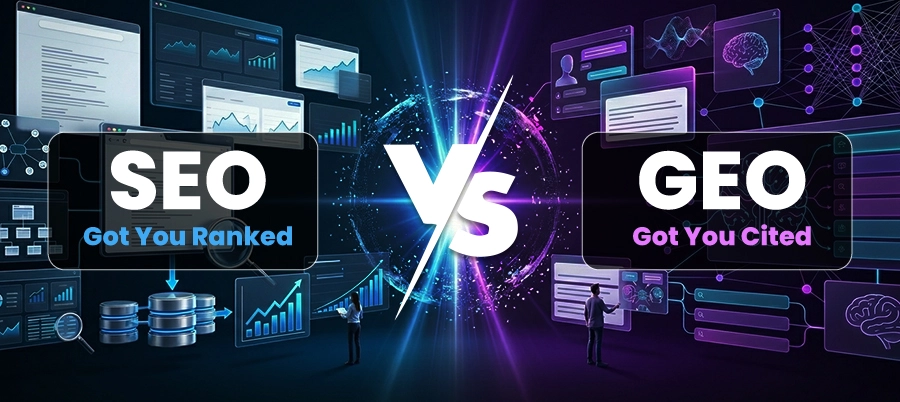
This is where the gap between SEO Vs GEO comes in 2026, understanding the difference between the two isn’t optional anymore. It’s survival.
What Is SEO (and Why It Still Matters)?
Search Engine Optimization: Is basically the practice of making your content visible to traditional search engines like Google and Bing. You know the drill:
· keyword research
· on-page optimization
· backlink building
· technical health,
· Core Web Vitals
The core output of SEO: Is a ranked blue link on a Search Engine Results Page (SERP). The user sees your page title, your meta description, clicks, and lands on your site. Traffic. Conversions. Revenue.
There is an established body of knowledge and experience around SEO. Over the years, we have acquired data, mature tools like Semrush and Ahrefs, documented best practices, and a community that has tested almost everything worth trying. If there were ever any changes to Google’s algorithm, then the SEO industry scrambles, adapts, and writes about it — loudly.
That’s the beauty and the burden of SEO: it’s mature, competitive, and increasingly crowded.
What Is GEO? Generative Engine Optimization Explained
Generative Engine Optimization (GEO) is the practice of making your content visible, trustworthy, and citable inside AI-powered search engines and large language models (LLMs) tools like ChatGPT, Perplexity, Google AI Mode, and Claude.
Instead of chasing a ranking position on a results page, GEO is about being the source an AI references when it constructs its answer.
Think of it this way: being cited by an AI is the new backlink. It signals authority. It drives awareness. And increasingly, it drives referral traffic often from users who are further along in their decision-making process than a typical organic visitor.
The term “GEO” was formally introduced in a 2023 Princeton research paper, and since then, it’s become quite the buzzword. So much so that some agencies are already charging up to $10,000/month just to manage AI citation strategy for their clients. The fundamental core, however, is learnable and that’s exactly what this will guide.
GEO vs SEO: The Core Differences
Here’s where the most marketers get confused. They assume you can “check a box” on a piece of content — optimize it for Google and AI at the same time and call it a day. That’s not how this works. Let’s break down the real differences:
1. The Output Is Completely Different
SEO gets you a ranked link on a results page. The user chooses whether to click.
GEO gets you cited inside an AI’s generated answer. The user may never visit your site — they receive your information through the AI’s voice. This is why GEO requires you to think about information influence, not just traffic.
2. The Ranking Factors Are Completely Different
Traditional SEO rewards: keyword relevance, backlink authority, click-through rate, page speed, and structured data.
GEO rewards: factual accuracy, authoritative sourcing, clear and structured writing, statistical specificity, and content that directly answers well-formed questions. LLMs don’t care about your domain authority score; they care about whether your content is trustworthy and citable.
3. The Competition Set Is Different
In SEO, you compete against other websites for the same keyword. In GEO, you compete to become the source an AI chooses when synthesizing an answer across many possible sources. Sometimes your biggest competitor for an AI citation isn’t even in your industry — it’s a research paper, a Reddit thread, or a Wikipedia entry.
4. The Measurement Framework Is Different
SEO metrics: rankings, organic traffic, click-through rate, domain authority.
GEO metrics: AI citation rate, brand mentions in AI responses, agent referral traffic, LLM brand sentiment. Most of these aren’t in your current analytics setup — yet. (We’ll cover the full new measurement framework in Part 8 of this series.)
5. The Speed of Change Is Different
SEO has years of case studies and agreed-upon best practices. GEO is growing rapidly and changing constantly — and as one experienced marketer put it, “we’re too early on for industry-agreed-upon best practices.” Anyone claiming a definitive GEO best practice checklist right now should be taken with a grain of salt. Trust sources that study multiple data points across hundreds of sites, not single-experiment claims.
Have a Look at a Real-Life FleetFlow Example
Take a look at the screenshot below. This is a traditional Google SERP for “small fleet taxi dispatch software.” FleetFlow ranks at Position #1 an SEO win, earned through keyword optimization, quality content, and solid technical foundations.
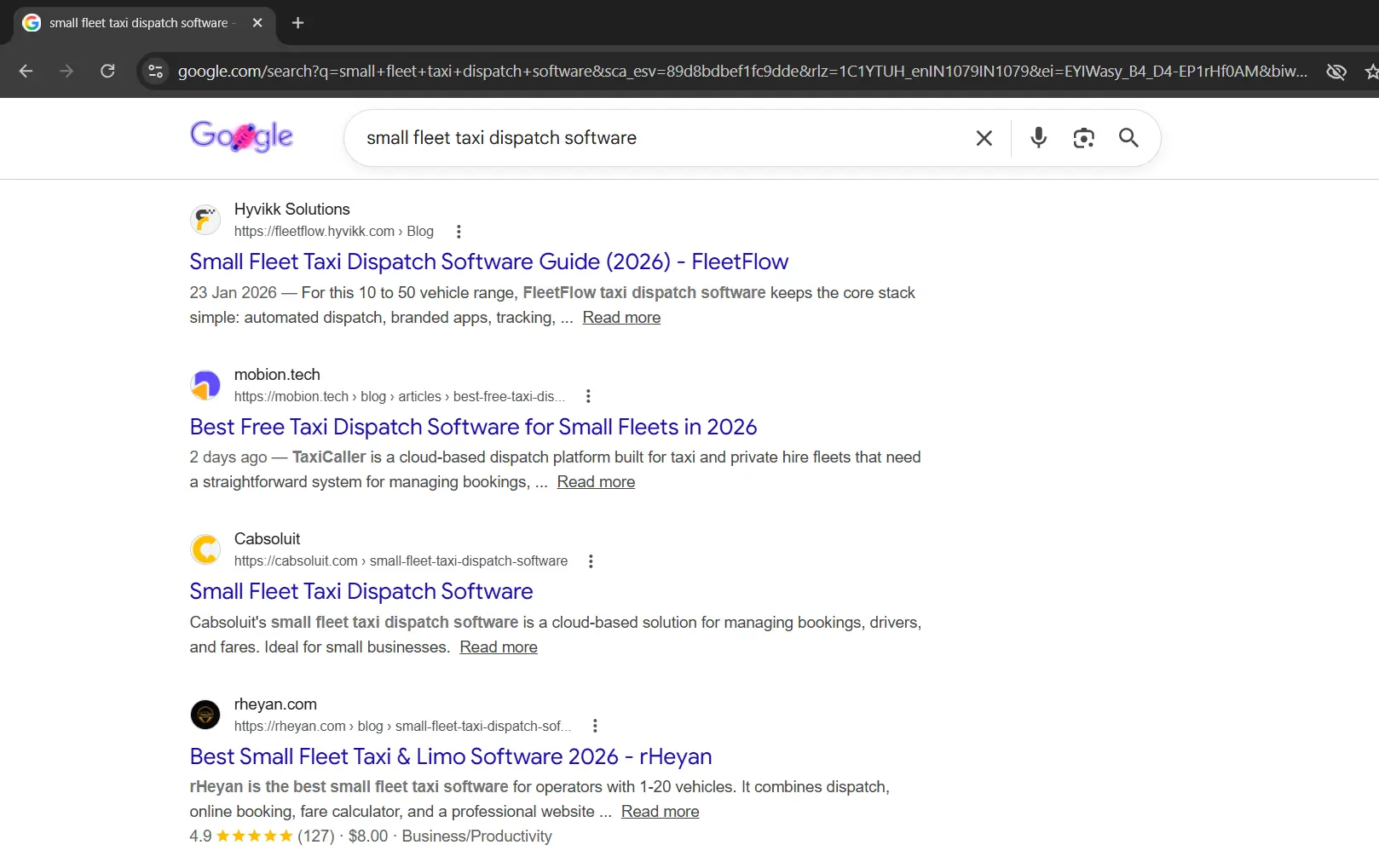
Show Image SEO in action: FleetFlow appears at Position #1 on Google for a competitive industry keyword.
This is traditional SEO working exactly as it should. The user searches, sees the ranked result, and decides whether to click.
Now imagine a different scenario. A fleet manager opens ChatGPT and types: “What’s the best dispatch software for a small taxi fleet?”
ChatGPT doesn’t return a list of blue links. It generates a synthesized response and it will cite two or three sources it considers authoritative, accurate, and well-structured. If FleetFlow’s content is optimized for GEO, it gets mentioned. If not, a competitor does.
Same product. Same industry. Two completely different games being played simultaneously.
GEO vs SEO: Which Is Better? (The Wrong Question)
Whenever someone asks “should I do SEO or GEO?” that’s actually the wrong framing.
The right question is: where is your audience going first?
If you serve a technically sophisticated audience developers, researchers, B2B decision-makers there’s a strong chance a significant portion of their discovery journey now starts in an AI tool, not on Google. That makes GEO a strategic priority.
On the other hand, if you target consumers with local searches, you have no choice but to stick to traditional SEO. It is still mostly traditional searches that are resolved by the traditional SERP from Google.
The smartest move in 2026 is to build a GEO SEO strategy not treating them as alternatives, but as complementary disciplines. Many GEO optimization techniques (authoritative writing, structured content, strong E-E-A-T signals) actually support your traditional SEO performance too.
One important nuance here is that entering Google AI Overviews might increase your visibility, while lowering your site traffic. At the same time, a click-through from ChatGPT or Perplexity is likely to convert better compared to a regular Google click since the person has been given a synthesized answer and wants more information.
That distinction matters a lot for how you prioritize your efforts.
How to Get Started with AI Search Optimization
You don’t need to overhaul everything overnight. Here’s exactly how I’d approach it and how we’ve been applying it with FleetFlow:
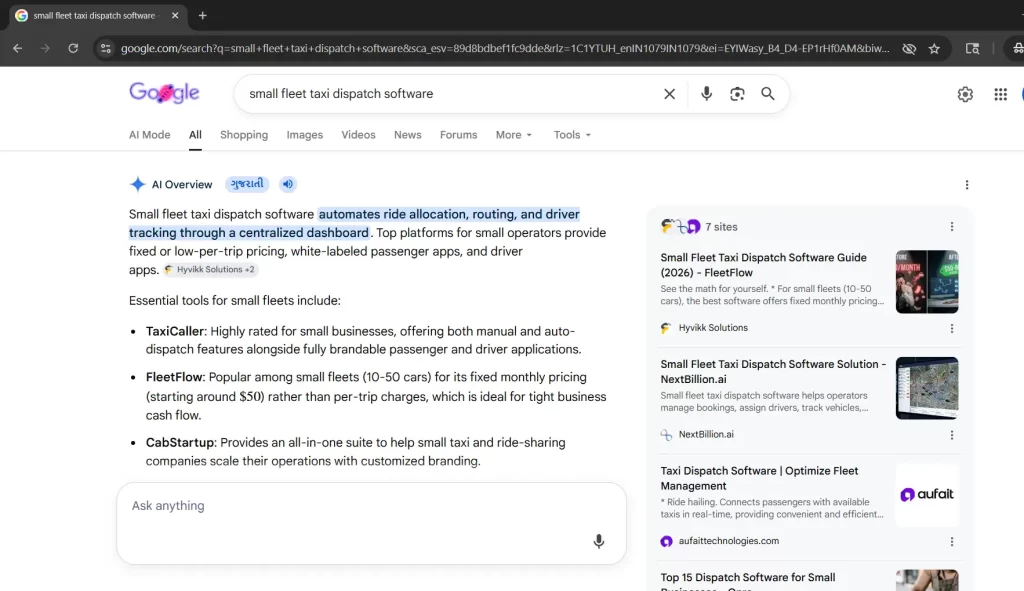
1. Identify your LLMs. Go into ChatGPT, Perplexity, and Google AI Mode right now and search “fleet dispatch software.” See who gets cited. That gap is your opportunity.
2. Write for authority, not just keywords. When we create content for FleetFlow, every claim is specific and sourced. Vague content might hold a Google ranking but it won’t survive an AI citation filter.
3. Structure to answer directly. FAQ sections, clean H2s, numbered steps. If an AI can’t parse your answer in three seconds, it’ll cite someone else.
4. Test and watch. There’s no fixed GEO playbook yet. We track FleetFlow’s AI referral traffic after every content update and iterate from there. That feedback loop is everything right now
FAQs
Q1. What is the difference between GEO and SEO?
SEO gets you ranked on Google. GEO gets you cited inside AI tools like ChatGPT and Perplexity. Same goal, visibility but completely different game.
Q2. Is GEO replacing SEO?
No. They run alongside each other. SEO owns traditional search; GEO owns AI-generated answers. You need both.
Q3. Do I need a different content strategy for GEO?
Yes. SEO rewards keyword optimization. GEO rewards factual, well-structured content that AI systems can confidently cite. The approach is different.
Q4. Is SEO still worth investing in?
Completely. SEO hasn’t died, it’s evolved. It still drives the majority of web traffic and remains a core channel in any serious digital marketing strategy.
Q5. How do I know if GEO should be a priority for my business?
Simple test: search your product category in ChatGPT or Perplexity. If your competitors show up and you don’t — GEO is already overdue.
The Bottom Line
SEO got you to Page 1. GEO gets you cited inside the AI answer itself.
These are not the same game, and they are not played with the same tools. The good news? Understanding the difference is the first and most important step and most of your competitors haven’t taken it yet.
In 2026, SEO is evolving into something deeper: Information Influence. You’re not just trying to rank for a keyword. You’re trying to ensure that when an AI thinks about your industry, your brand is the most trusted fact it reaches for.
Over the next eight posts in this series, we’ll go from diagnosis to execution — covering why your traffic is dropping, how to get cited by ChatGPT and Perplexity, what agentic SEO looks like in production, and what metrics you should actually be measuring.
The playbook is being written right now. Let’s get ahead of it.
Sorry, the comment form is closed at this time.