21 May AI Sovereignty: The System Deciding More Than You Think
You can own your data, control your infrastructure, and audit your software – but can still lose your independence if AI making decisions doesn’t belong to you.
We have spent four articles building sovereignty stack layer by layer from digital independence to data control, from physical infrastructure to software ownership. Now we arrive at the layer that sits above all of them and quietly governs every decision made across the entire stack.
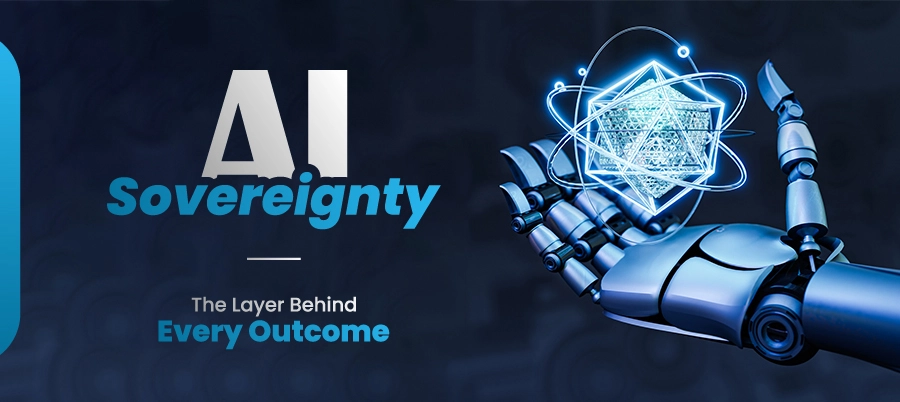
AI sovereignty is the newest, most strategically task management of national and organizational independence. As artificial intelligence moves from a convenience tool to a critical decision-making infrastructure governing healthcare allocation, national security threat detection, financial systems, and public policy who builds, trains, and controls that AI is no longer a technology question, but rather become one of the Power.
Definition – What AI Sovereignty Is?
AI sovereignty is an organization’s or nation’s capacity to produce, deploy, and govern artificial intelligence using its own infrastructure, data, workforce, and legal frameworks — without strategic dependence on foreign technology stacks, proprietary models, or external AI providers that operate outside its jurisdiction or values.
That definition comes deliberately close to how IBM, NVIDIA, and the World Economic Forum frame it — because the convergence across these institutions signals that AI sovereignty has crossed from academic debate into mainstream strategic doctrine.
Why AI Is the Layer That Controls Everything Else
Imagine the absurdity of partial sovereignty. A government can store all its citizens’ data in the nation itself. A government can do so by hosting all data in national servers, which will satisfy its needs for infrastructure sovereignty. It can go further by using open-source software to interpret the data that it has collected. However, what would happen if the AI algorithm used to interpret the data, predict fraud, give policy recommendations, and identify security risks was trained on foreign data with foreign preferences?
AI algorithms don’t just run on the stack but reason through the stack too. An AI algorithm designed with certain biases or interests can subtly manipulate its conclusions without leaving any audit trail behind. This is precisely why AI sovereignty is a must-have for all nations that want real independence in this new era.
“Without AI sovereignty, countries risk being nothing more than consumers of AI services and falling into the trap of being the technology’s consumer in the 21st century.”— World Economic Forum, Sovereign AI Framework, 2024
The 6 Pillars of AI Sovereign
The Six-pillar Framework presented by the WEF in 2024 outlines the key considerations for achieving sovereignty in AI for countries and organizations. Each of these pillars is tied to one of the previously discussed aspects in this series:
1. Data Infrastructure and Domestic Data
AI models can only be truly sovereign to the degree that the data used to train them is sovereign. For this reason, the first pillar is Data Governance, which we have discussed in Part 2.
2. Sovereign AI Infrastructure
The infrastructure required to run an AI model is similar to the infrastructure required to train it, and this is discussed in part 3. The NVIDIA report on Sovereign AI explicitly highlights GPUs as a sovereignty asset.
3. AI Workforce and Domestic Expertise
AI sovereignty needs the workforce to develop, test, and monitor it. Outsourcing AI expertise means outsourcing AI sovereignty itself. India and Canada are spending considerable effort into developing their own AI talent pipelines.
4. Legislation and Policies Governing AI
The upcoming EU AI Act, Indian regulation in AI, as well as the new institute for AI safety in the UK – these examples show efforts to establish legal jurisdiction over AI within national territories.
5. Transparency and Auditability of AI Models
Foreign companies’ closed models cannot be tested for potential abuse. The software sovereignty model can be directly applied to this domain as well – there are sovereign AI solutions like Llama, Mistral, and Indian Krutrim.
6. Interoperability Standards
Even sovereign AI needs to interact with foreign entities. This way, countries have to be involved in the development of global AI interoperability standards rather than accept them as they are provided.
What Countries with AI Sovereign Look Like
Perhaps the best way to determine that AI sovereignty has been implemented into policy is the variety of countries that are pursuing this strategy. These countries do not merely speak of AI sovereignty but actually implement programmes that are both funded and structured.
India
The Indian government’s IndiaAI Mission includes an investment of ₹10,371 crore to establish compute domestically, to fund foundational models, and to construct a sovereign AI dataset framework. The Krutrim initiative, which is India’s first AI unicorn, highlights the domestic model strategy.
European Union
The EU AI Act, along with the EuroHPC initiatives, are the most comprehensive attempts at regulating AI sovereignty, placing an emphasis on legal jurisdiction, ethics, and compute capacity simultaneously.
Canada
Canada leverages its academic AI dominance in a pan-Canadian AI strategy, which includes investments in computing power and talent retention to avoid the brain drain to US hyperscalers.
United Kingdom
The AI Safety Institute in the UK, along with compute sovereignty initiatives, makes the country a frontrunner in the area of AI safety and governance-first AI sovereignty.
The Definitional Problem and What Actually AI Sovereignty Means
HAI at Stanford University found a key contradiction in their work related to AI sovereignty. Most of the current definitions of sovereign AI focus on technical and organizational sovereignty, including computing power, models, and data. However, this focus leaves out the element of national sovereignty from consideration.
A company might become technically sovereign in terms of AI because it owns its own models and runs them independently. At the same time, it will rely on the foreign architecture of its computing chips, foreign processes to train its data, and even foreign methods of conducting research. Sovereign AI needs solutions to all aspects of the problem simultaneously; that is why this five-part series is important.
FAQs which People Also Ask Like for AI Sovereignty
1. What is AI sovereignty?
It is a nation’s or organization’s ability to build, govern, and control its own AI systems using domestic data, infrastructure, workforce, and legal frameworks without strategic dependence on foreign AI providers.
2. What countries have sovereign AI?
India, the EU, Canada, the UK, France, Brazil, Saudi Arabia, and the UAE all have active sovereign AI strategies. Chile and Taiwan are investing in homegrown open-source models for cultural and strategic autonomy.
3. What is an example of a sovereign AI?
India’s Krutrim model, France’s Mistral AI, and the UAE’s Falcon model are examples of domestically developed AI systems representing sovereign AI in practice.
Conclusion – AI Sovereignty Is Where the Entire Stack Point
Every piece of this series has been building toward this point. Your digital sovereignty framework defines the intent. Your data sovereignty strategy secures the raw material. Your infrastructure sovereignty provides the compute backbone. Your software sovereignty ensures the logic layer is auditable and independent. And AI sovereignty is what determines whether the intelligence layer, the system that reasons, decides, and acts across all of it actually serves your interests or someone else’s.
Nations and organizations that approach AI sovereignty as a purely technical challenge will miss it. Those that approach it as a purely political challenge will also miss it. The answer requires building across all five layers — simultaneously, deliberately, and with a clear-eyed understanding that the stakes are not abstract. They are the practical conditions of independence in the 21st century.
The sovereignty stack is complete. The work of building it has just begun.
Sorry, the comment form is closed at this time.