18 May Software Sovereignty: You think you own your software but actually, you’re just renting control
You’ve built digital systems, secured your data, and locked down your infrastructure. But here’s the uncomfortable question no one asks in the boardroom: Do you actually own the software running all of it?
Most organizations – from startups to sovereign governments would answer “yes.” They are wrong. Buying a software license isn’t ownership. Utilizing a SaaS platform is not control. And in a world where a single change made by vendor update, a geopolitical shift, or a change in terms can isolate your operations overnight, that distinction matters more than ever.
This brings us to an essential yet often overlooked layer of a much larger digital control problem: Software Sovereignty.
What Is Software Sovereignty?
Software sovereignty is an organization’s or nation’s ability to fully control the software it depends on — including the right to inspect, modify, audit, deploy, and continue using that software without depending on a third-party vendor’s permission, pricing decision, or continued existence.
The core differentiation says: Software sovereignty is not about which software you use. It’s about whether you have genuine, single-handed control over that software’s future — its code, its deployment, its data flows, and its data flows, and its long-term availability.
Because:
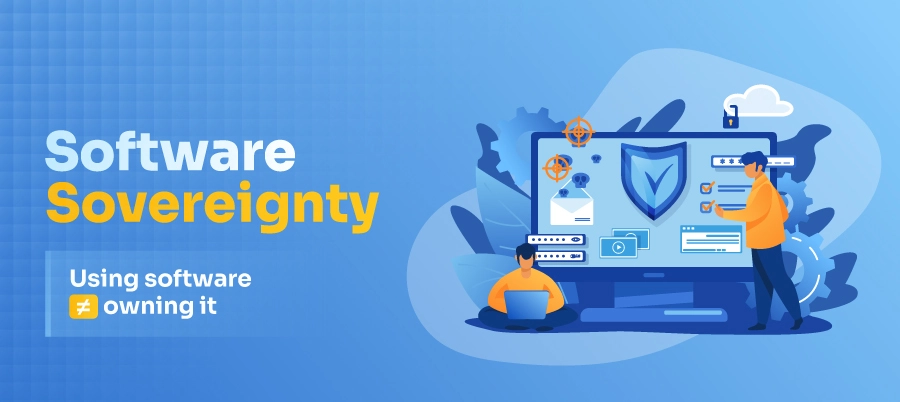
Expensive software ≠ control
Access ≠ ownership
Only control = sovereignty
Why It Matters More Than Ever
The modern software ecosystem has quietly made most organizations deeply dependent on vendors they do not control. Consider a few uncomfortable truths as:

Vendor Lock-In
Vendor-specific software solutions are crafted to make it difficult for you to switch vendors. Your data may be extractable; however, the workflow integration will prove challenging.
Geopolitical Risk
US export controls have already blocked specific entities from using American cloud software. No contract protects you from a government order.
License Revocation
Software licenses can be revoked, repriced, or discontinued. You will never know when the licensing agreement you have signed today becomes void tomorrow.
Opacity & Trust
Closed-source software cannot be independently audited. You are trusting a vendor’s security claims rather than verifying them yourself.
This is not some theoretical scenario.
In 2022, multiple Russian businesses suddenly found themselves unable to use Adobe, Oracle, SAP, and Microsoft applications due to sanctions. The organizations who relied on these technologies were trapped; No source code, No fallback plan, No sovereignty.
“Software sovereignty isn’t a luxury for governments. It’s a survival strategy for any organization serious about long-term independence.”
How To Achieve Software Sovereignty
Achieving software sovereignty isn’t about abandoning all vendors . It means building a deliberate strategy — starting with your most critical systems and expanding outward.
1. Audit your software dependencies – Map every piece of software your organization critically depends on. Classify each by vendor lock-in risk, geopolitical exposure, and availability of open-source alternatives. Most organizations doing this exercise for the first time are genuinely surprised by how concentrated their risk is.
2. Prioritize open-source where it matters most – Open-source software gives you the right to inspect, modify, and self-host. Tools like Linux, PostgreSQL, LibreOffice, Nextcloud, and increasingly AI frameworks like Ollama represent sovereign-compatible alternatives to proprietary giants. Open source is the foundation of software sovereignty — not because it’s free in cost, but because it’s free in control.
3. Self-host critical workloads – Where possible, run essential workloads on infrastructure you control. A self-hosted system may require effort — but it removes dependency on external decisions. Especially in uncertain geopolitical environments, this becomes a strategic advantage.
4. Establish software exit strategies – For every critical vendor dependency ask: What happens if this stops tomorrow? How fast can we move? What is the alternative? Having an answer before you need it is what sovereignty looks like in practice.
Real-world Case Study: Germany’s Open-Source Shift
The German government has undertaken one of the world’s most deliberate software sovereignty programs, migrating state institutions toward open-source alternatives including LibreOffice and Linux-based operating systems. Driven by concerns about NSA surveillance revelations and vendor dependency, Germany’s approach illustrates that software sovereignty is a government-level strategic priority — not just a technical preference.
Software Sovereignty vs. Data Sovereignty: The Critical Distinction
These two concepts are frequently and dangerously — conflated. Your data sovereignty strategy might ensure that your data physically resides within your borders, subject to your laws. But if the software processing that data is a proprietary black box controlled by a foreign corporation, your sovereignty is incomplete.
Think of it this way: Data sovereignty tells you where your information lives. Software sovereignty tells you who controls the logic that processes, transforms, and acts on it. These two are equally important; one without the other will create a gap and that could be exploited by adversaries.
Cloud Software Sovereignty and the AI Governance Challenge
Cloud-native software has redefined how organizations operate. But it has also changed what “software” actually means.
In many cases, you are no longer running software.
You are consuming outputs.
- APIs
- AI models
- managed services
The vendor controls:
- the system
- the logic
- the pricing
- the future
This raises critical questions:
- Can you audit the system?
- Can you reproduce results independently?
- Can you operate without the vendor?
As AI adoption grows, software sovereignty and AI governance are becoming inseparable.
Conclusion
Software often feels invisible because it runs quietly in the background.
But that invisibility hides dependency.
Because in 2026, the real risk is not just using software —
it’s relying on software you don’t control.
You may own your data.
You may control your infrastructure.
But if the software on top is vendor-controlled, your independence remains limited. That’s why software sovereignty is not optional. Because access is not ownership. Control is
Control is.
FAQs
1. What is software sovereignty?
Software sovereignty means having full control over the software you use, including its code, deployment, and long-term availability.
2. Why is software sovereignty important in 2026?
Because most organizations rely on vendor-controlled software, which can change, restrict access, or create dependency without warning.
3. How does SaaS affect software sovereignty?
SaaS platforms provide convenience but reduce control, as the vendor manages the software, updates, and access policies.
4. What are the risks of not having software sovereignty?
Risks include vendor lock-in, license changes, lack of transparency, and inability to operate independently.
5. How can organizations improve software sovereignty?
By auditing dependencies, using open-source tools, self-hosting critical systems, and planning exit strategies from vendor platforms
Sorry, the comment form is closed at this time.