
Google Ads AI Max represents one of the most significant automation shifts in search advertising since Performance Max. By replacing traditional Dynamic Search Ads (DSA) and combining broad-match keywords with automatically generated assets.
Here is a guide to what AI Max is, what will be migrated in February 2027 and how to maintain control over your ad spend.
What AI Max is and where it stands?
Google Ads AI Max is not a new campaign type. According to Google, AI Max is an optimization layer that gets turned on within an existing Search campaign, along with your keywords. AI Max provides you with three main functionalities:
- Broader Search Term Matching: Identifies more relevant customer queries than what is found in your manual keyword list.
- Text Customization: Automatically generates tailored headlines and descriptions by applying the existing ads and website texts.
- Final URL Customization: Redirects users to the most relevant landing page on your website according to their search intent.
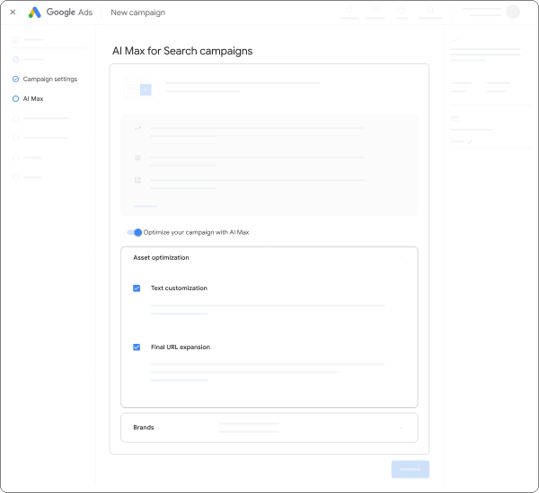
It adds brand, location and URL controls and Google says it needs conversion-based Smart Bidding and a campaign that isn't limited by budget. AI Max left beta on 15 April 2026, and new Search campaigns now have it switched on by default.
Because automated PPC campaigns bridge both paid search and broader web acquisition channels, understanding how paid campaigns fit alongside your overall digital marketing vs internet marketing strategies keeps your overall budget aligned.
What was auto-upgraded in September and what did it change?
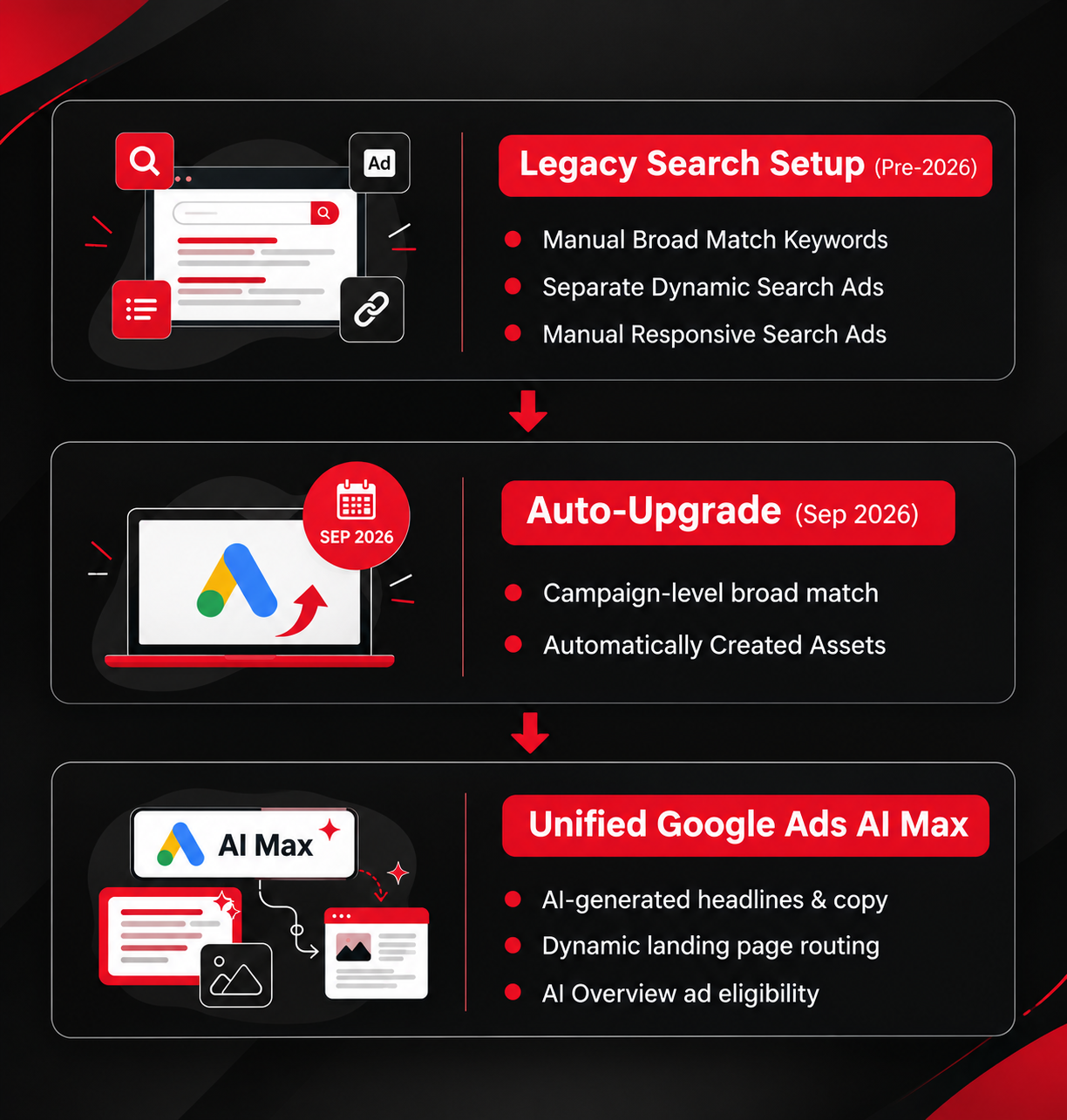
The September 2026 auto-upgrade brought broad match setups and asset generation under the AI Max framework.
Key Changes Introduced
- Asset Generation: AI Max creates headlines and descriptions by drawing from your landing page content, existing ad copy and domain context.
- Search Intent Expansion: Query matching depends less on exact keyword syntax and more on semantic meaning and landing page context.
- Consolidated Reporting: Performance metrics for asset generation and broad targeting now stream through unified AI Max campaign dashboards.
What to check now: in your search terms report, find the "AI Max" match type and source column, then compare performance before and after the upgrade.
Dynamic Search Ads: The February 2027 Migration
Google says campaigns using DSA will be automatically upgraded to AI Max starting in February 2027. The timeline in one place:
15 January 2027: In-account notifications and email reminders begin rolling out to advertisers.
1-28 February 2027: Automatic migration window for all remaining DSA campaigns into AI Max.
Migration Timeline Schedule
| Date | Milestones | What to do |
| 15 April 2026 | AI Max leaves beta; DSA upgrade tools roll out | Optional opt-in for testing |
| 1-30 September 2026 | Broad match & ACA auto-upgrade | Audit existing broad match campaigns |
| 15 January 2027 | Migration reminders sent | Finalize DSA transition plans |
| 1-28 February 2027 | Full DSA migration window | Run side-by-side experiments or auto-migrate |
As per Google Ads Help , the upgrade turns dynamic ad groups into standard ad groups and DSAs into responsive search ads with legacy URL rules becoming read-only. If Google upgrades you, it says all three AI Max features are enabled with your legacy URL controls preserved. If you upgrade yourself, you choose the settings first. Google's Ads Community has a thread on what's changing.
Ads in AI Overviews and AI Mode: Confirmed vs Reported
One of the biggest advantages of using AI Max is the increase in ad placements on Google's latest interfaces.
- Confirmed By Google: AI Max ad campaigns use landing page context to align with search queries in dynamic search placements, leveraging conversational search context to serve ads.
- AI Overviews & AI Mode: According to industry reports, one of the major criteria of placing an ad in Google AI Overviews and AI Mode conversational search results is being eligible for AI Max campaign placement. Make sure that you optimize your landing page content for AI generation according to Google guidelines.
To make sure your landing pages and site architecture are fully ready for these placements, follow Google's official AI search guidance to optimize your content for generative AI.
Campaign Guardrails: how to maintain control
Automation requires strict boundaries to prevent budget waste and brand dilution.
- Negative Keyword Lists: Implement account-level negative keyword lists to block irrelevancies across AI Max search expansions. Regularly audit the search term insights to capture low-intent queries.
- Brand Protections: Put your branded keywords in separate campaigns and implement exclusions within AI Max campaigns to protect brand conversions against bidding up from automated bid adjustments.
- Landing Page Exclusions: Prevent AI Max from crawling non-commercial pages like blog archives, career portals, policy pages or term pages using explicit URL exclusion rules.
- Pinned ads and tracking: with final URL expansion on, pinned assets aren't respected and a tracking template without a compatible one can send people to a broken page. Test both.
- Incrementality Checks: Monitor conversion sources to check whether AI Max generates new sales or competes with your existing exact-match search traffic.
A 30-Day AI Max Test Plan
Use a free Google Ads account and Google Keyword Planner to review your keyword and negative lists first.
Follow this structured timeline to test AI Max before the February 2027 auto-migration window:
- Days 1-7 (Setup & Baseline): Select a successful DSA campaign. Launch an AI Max experiment with a 50/50 budget split. Configure URL exclusions and set brand keyword safeguards.
- Days 8-14 (Learning Phase): Let Google's machine learning algorithm to optimize without manual bid or asset interventions. Track early search terms for irrelevant queries and include them as negative keywords immediately.
- Days 15-21 (Mid-Point Evaluation): Check CPA, Target ROAS and conversion tracking efficiency. Compare the cost per conversion rate between your control DSA campaign and the AI Max experiment.
- Days 22-30 (Optimization & Decision): Analyze overall performance gains. If AI Max achieves equal or better results at a lower cost with more conversions, schedule a complete switch before the 15 January 2027 notification deadline.
Low conversion volume or a long sales cycle? Extend the test.
FAQs
When do Dynamic Search Ads move to AI Max?
According to Google, the automatic migration is scheduled for February 2027 as Google has extended its earlier deadline of September 2026.
Do I need AI Max to show ads in AI Overviews or AI Mode?
No, standard Search, Shopping, Performance Max and broad match campaigns are also eligible to show there.
Can I test AI Max before the automatic migration?
Yes, you can run a 50/50 one-click experiment inside Google Ads to test AI Max against your current campaigns.
Will AI Max reset my negative keywords or brand setting?
No, all existing negative keywords, brand inclusion and exclusion rules and URL policies will be transferred automatically.
Is it possible to disable certain AI Max features individually?
Yes, for example, it is possible to enable or disable automated text modification and final URL expansion separately.