

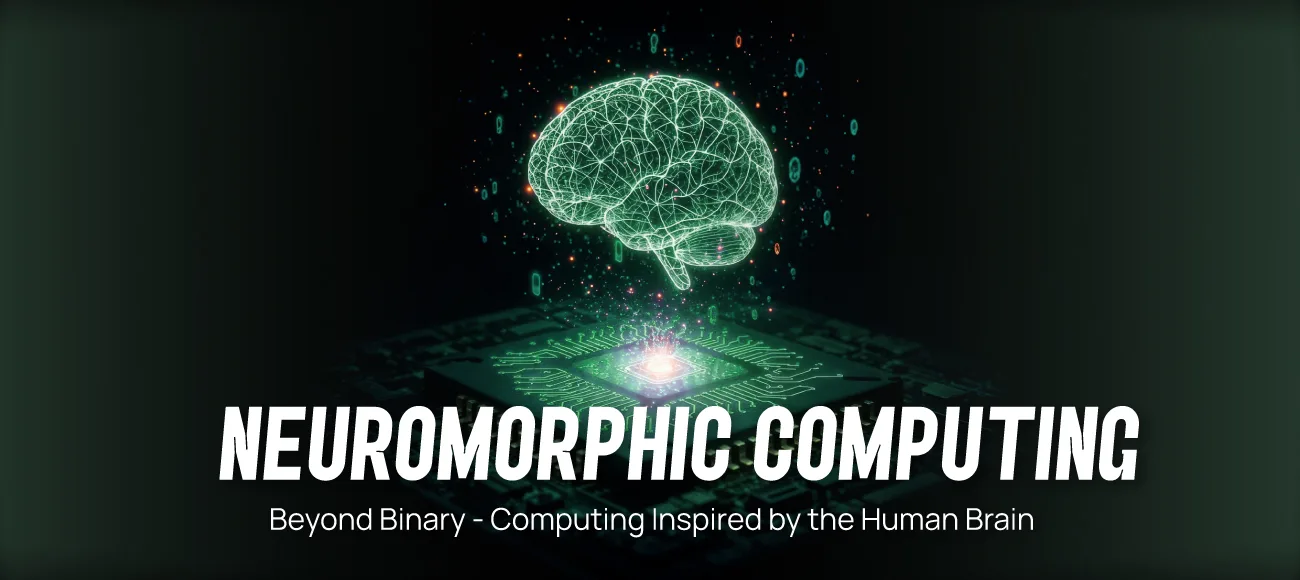
22 Dec Neuromorphic Computing: Brain-Like Technology of the Future
Brain-like Computing — Technology that mimics the behaviour of the human brain
In the digital era, neuromorphic computing has emerged as a transformative method of computation. It imitates the way the human brain functions, such as understanding context, learning from experience and producing adaptive and predictable outcomes through artificial neurons and synapses. These interconnected structures form complex networks that are solved with high efficiency.
What is Neuromorphic?
Neuromorphic computing is a brain-inspired technology that aims to replicate how the human brain processes information. This model integrates principles into computer architecture and design to create systems that think and learn more naturally. Unlike conventional computing, which relies on binary logic (0s and 1s) and sequential processing, neuromorphic systems are designed to build the brain’s event-driven and parallel processing mechanisms.
By leveraging spiking neural networks (SNNs) and synaptic plasticity, neuromorphic hardware and software achieve greater computational efficiency, ultra-low power consumption, and adaptive learning capabilities. These systems can process sensory data in real time, learn continuously, and operate effectively in dynamic and unpredictable environments — much like the human brain itself.
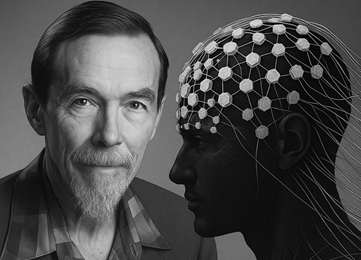
“Neromorphic Computing means designing and engineering computer chips that use the same physics of computation as our own nervous system.” — Carver Mead
History of Neuromorphic Computing
Neuromorphic computing was introduced in the 1980s by Carver Mead, who aimed to design computer chips that function like the human brain. His idea inspired the creation of brain-like processors such as IBM’s TrueNorth, Intel’s Loihi, and SpiNNaker, marking the beginning of computers that can learn, adapt, and process information intelligently.
Limitations of Traditional Computing
We often discuss about how traditional computing is reaching its limits. To overcome these challenges, Neuromorphic computing uses an event-driven architecture. It is more energy-efficient, adaptable and better suited for tasks such as perception and pattern recognition. Basically, the role of neurons in the brain is played by the perceptrons in a neural network. Instead of continuous, clock-based processing, it processes information only when necessary — similar to how biological neurons fire only when a threshold is reached.
Neuromorphic Hardware & Processing Chips
Neuromorphic computing relies on specialized hardware designed to emulate neural activity rather than execute linear code. Some key examples include:
· IBM TrueNorth – Developed by IBM, this chip contains over 1 million neurons and 256 million synapses, designed to perform parallel computations efficiently with minimal power usage.
· Intel Loihi – Intel’s Loihi chip has adaptive learning capabilities, allowing it to learn from its environment in real time using on-chip learning mechanisms. It supports spiking neural networks, making it a true hardware realization of neuromorphic design.
· SpiNNaker (University of Manchester) – A large-scale, massively parallel computing platform that uses digital neurons to simulate brain-like processes, capable of modeling up to a billion neurons.
These processors differ fundamentally from CPUs and GPUs by being event-driven, asynchronous, and energy-efficient, enabling them to perform cognitive tasks with a fraction of the power required by traditional architectures.
REAL-WORLD APPLICATION
Neuromorphic computing has diverse applications across various domains due to its brain-like efficiency and adaptability. Includes as:
1. Artificial Intelligence (AI) and Machine Learning
o Enhances edge AI devices by providing faster inference and on-device learning.
o Improves pattern recognition, decision-making, and adaptive control in real time.
2. Robotics and Automation
o Enables robots to perceive, adapt, and respond to dynamic environments efficiently.
o Used for autonomous navigation, gesture recognition, and object detection.
3. Healthcare and Biomedical Engineering
o Assists in developing brain–computer interfaces (BCIs) and neuroprosthetics.
o Supports real-time data interpretation in medical imaging and diagnostics.
4. Smart Devices and IoT (Internet of Things)
o Powers intelligent sensors that process data locally instead of sending it to the cloud.
o Ideal for smart cities, surveillance, and energy-efficient devices.
5. Autonomous Vehicles
o Helps vehicles interpret environmental cues in real time for navigation, obstacle avoidance, and decision-making.
6. Defense and Aerospace
o Used for situational awareness, signal processing, and autonomous control systems in drones and spacecraft.
Future Scope
The future of neuromorphic computing is very promising and connected to many different fields. It is expected to become an important part of the next generation of artificial intelligence because it can learn continuously, work faster, and use much less power. When combined with the Internet of Things (IoT), it will help devices process data in real time without always needing the cloud. Scientists also believe neuromorphic computers could one day simulate parts of the human brain to help understand how it works. In the future, combining neuromorphic, quantum, and traditional computing may create smart systems that can think, understand, and learn more like humans.
Summary
Neuromorphic computing represents a major shift in how machines process information — moving from rule-based logic to adaptive, self-learning intelligence inspired by the human brain. With continuous advancements in neuromorphic hardware, algorithms, and materials, this technology is set to redefine computing efficiency and enable a new generation of intelligent, energy-efficient systems capable of thinking, learning, and evolving.
Sorry, the comment form is closed at this time.