Over the past two years, there have been some unconventional statements in digital marketing forums about SEO being dead, websites needing special .txt files for Large Language Models and the "AI schema hacks", which will be the only thing needed for websites to appear in generative search engines.
On May 15, 2026, Google put all the rumours to rest with their formal guidance in Optimizing your website for generative AI features on Google Search. Then, on September 24, 2026, Google expanded this ecosystem even further by rolling out official Web Multimodal Search Performance Reporting inside Google Search Console, allowing marketers to track visual-led AI traffic (Google Lens, Circle to Search and image uploads) right next to the text-based AI Overviews.
Their overarching message was? Generative AI visibility relies on strong SEO fundamentals, clear structure, updated content and high-quality visual context without technical gimmicks.
Here is a simple breakdown of what Google's new 2026 guidance actually means for your digital marketing strategy, what tactics you should be considered and how to get your site ready for AI search this year.
1. Google Finally Makes GEO and AEO Official
Although concepts such as Generative Engine Optimization (GEO), which was first defined in a paper published by Princeton University and Answer Engine Optimization (AEO) have been used by marketers for months, search engines had never defined them officially until now.
With its new announcement, Google confirms that GEO and AEO are not separate "secrets". Rather, they are simply the modern framework for how AI search engines read, synthesise and cite web pages inside AI-driven search results.
Want the deeper breakdown? Read [ SEO vs GEO vs AEO: Which One Does Your Brand Need? ]
2. What Google's 2026 Guidance Says
The key takeaway from Google’s documentation is straightforward & simple: Google AI Overviews retrieve information directly from the standard Google Search index.
Google’s generative systems use a process called Retrieval-Augmented Generation (RAG). Before an AI Overview gives an answer to a user, it first searches through the standard Google's standard web index for trusted, topically relevant pages.
Unless your website isn't indexed, crawlable and properly optimized for standard SEO, it won't appear in AI search results. Put simply: GEO is an extension of traditional SEO, not a replacement for it.
3. The AI-Specific Hacks Google Says You Don't Need
Google’s official guide explicitly myth-busts trending shortcuts, pointing out that several popular tactics won’t help your AI search visibility:
5 Hacks Google Says You Don't Need
llms.txt Files: Creating special machine-readable text files in your root folder provides no priority or advantage in AI search indexing.
- Aggressive Content Chunking: Dividing your content into very small text chunks artificially is unnecessary. Google's algorithms already understand multi-topic pages naturally.
- Special "AI Schema" Markup: There is no special AI schema markup. Standard schema markup works great for rich results, but it won’t get to unlock AI answers either.
- Keyword Stuffing for AI Prompts: Rewriting subheadings into long, unnatural conversational phrases offers no ranking advantage.
- Duplicate "AI-Only" Pages: Publishing pure text versions of your web pages creates duplicate content issues without helping rankings.
4. The Real Opportunity: Non-Commodity Content, Structure, Freshness & Multimodal Assets
To create high-quality, non-commodity content that aligns with Google's standards, focus on these four essential pillars.
Non-Commodity Content
Generic definitions can easily be written by AI. To get cited as a primary source in an AI Overview, your content must offer original value:
- Real experience, case studies and proprietary data.
- Real opinions and unique expert insights.
- Clear solutions to specific real-world problems.
Document Structure & Organization
Clear structure helps Google’s AI parse your page quickly:
- Use clean heading hierarchies (H2, H3).
- Provide a direct, 1-2 sentence answer right under key subheadings.
- Use HTML tables for fast comparisons.
2026 Freshness Advantage
Fresh content is crucial for generative search optimization. According to the latest industry data from Ahrefs (17 million AI citations analysis) and ConvertMate , the freshness of content that was updated within the last few days is much more likely to earn higher AI citation rates than older and unmanaged posts.
Multimodal AI Search Tracking
With the introduction of the new Search Console update in September 2026, traffic generated from multimodal AI searches such as Google Lens, Circle to Search and image uploads can be separated in the Performance report using the "Web: Multimodal" search type filter in the Search Console. Making sure you have high-quality photos, good alt text, and entity schema is just as crucial as text optimization.
5. Why freshness now matters for rankings and AI answers
AI search isn't just changing how search engines read content; it's changing how people are searching.
According to data from BrightEdge, AI Overviews appear on roughly 48% of tracked search queries (with broader studies showing a range of 13% to 60% depending on the topic). In addition, Research from Pew Research Center also points out key shifts in search behavior:
Basic factual searches lead to fewer clicks: Simple queries (e.g., "What is an AI Overview?") are answered instantly right at the top of the page.
Citation clicks also carry higher intent: When users click on a source link inside an AI Overview, they are looking for in-depth expertise, product options or agency services.
Curious how brands actually show up in these answers? Read [ AEO in Action: How Brands Get Found in AI Search ].
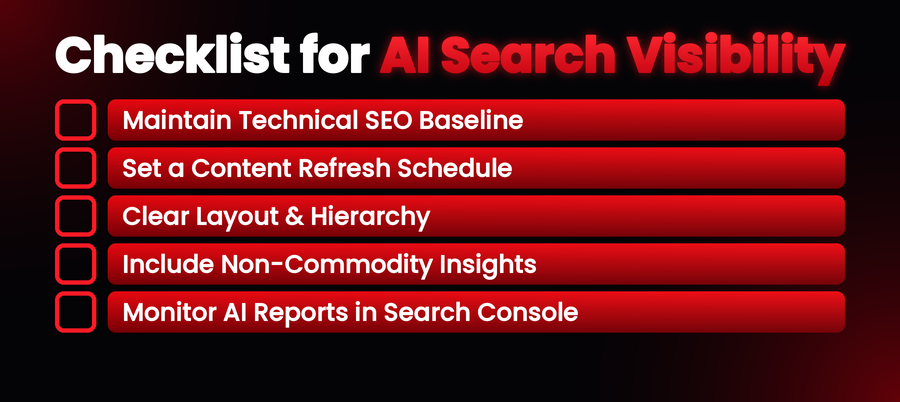
6. A Practical 2026 Checklist for AI Search Visibility
Follow these steps to optimize your site based on Google's official 2026 guidelines:
7. How Hyvikk Approaches Digital Marketing for the AI Search Era
At Hyvikk , we assist organisations in creating well-structured and Google-friendly digital marketing strategies, without chasing temporary tactics or getting into any kind of shortcuts.
Our approaches on digital marketing strategy focuses on:
- Strong foundation: Ensuring your site structure, local listings, and technical health satisfy Google's guidelines.
- Authoritative Content Creation: Producing valuable content that answers customers' questions and gets cited by AI.
- Multimodal & AI Tracking: Monitoring performance across traditional search, AI Overviews, and multimodal discovery using the latest Search Console reporting tools.
Ready to See Where Your Site Actually Stands?
Find out how your website performs in the modern search. The question is whether your site is built for it yet. If not Get a free digital marketing audit from Hyvikk with, step-by-step optimization plan.
Looking for expert support? Explore our complete Digital Marketing Services , Search Engine Optimization Services and Consulting Services.