

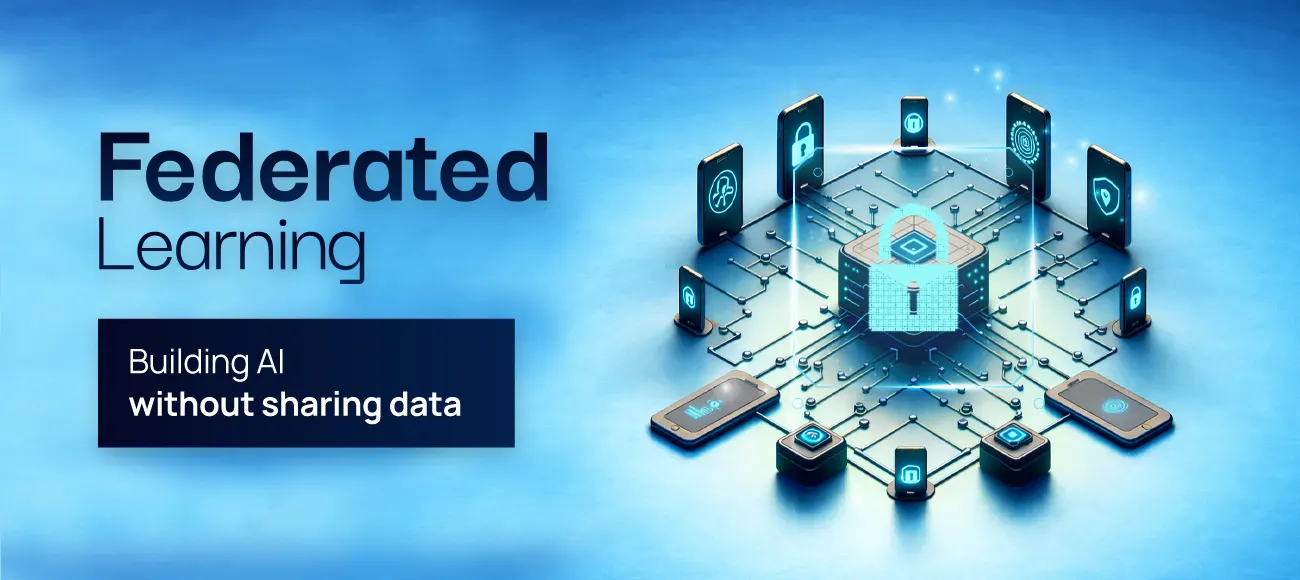
26 Feb Federated Learning: The Future of Privacy-Friendly AI Innovation
Introduction
We live in a world where data is constantly being created. Every time we type a message, search online, use a fitness app, or make an online payment, data is generated. Companies use this data to improve their services and build smarter AI systems.
But here’s the problem — people are becoming more aware of their privacy. No one feels comfortable knowing that their personal chats, health records, or banking details are stored on big central servers.
Meanwhile, AI systems need large amounts of data to become accurate and useful.
So how do we balance innovation and privacy?
This is where Federated Learning comes into picture. It provides a smarter and safer way to train AI models without collecting sensitive personal data in one place.
What is Federated Learning?

Federated Learning is a method of machine learning technique in which a model is trained on multiple devices without transferring the data from those devices.
“ Instead of sending data to the model,
we send the model to the data. ”
Once the training is completed, only the model updates (not the actual data) are sent back to a central server. The server combines updates from many devices to improve the overall model. This way, personal data stays on the device, which ensures the privacy of the user while improving the AI system.
Who introduced Federated Learning?

Federated Learning was introduced by Google in 2016.
Google wanted to improve features like keyboard word prediction without collecting users’ private messages. So, they developed this new approach where phones train the model locally and send only small updates back.
Since then, Federated Learning has become an important topic in AI research and industry.
How does it work?
Let’s understand it step by step:
Step 1: Initial Model Creation
A central server creates a basic machine learning model.
Step 2: Model Sent to Devices
The model is sent to multiple devices (like smartphones or edge devices).
Step 3: Local Training
Each device trains the model using its own local data. The data never leaves the device.
Step 4: Send Updates (Not Data)
After training, each device sends only the model updates (like weight changes) to the central server.
Step 5: Aggregation
The server combines all updates to create an improved global model.
Step 6: Repeat
The updated global model is again sent to devices for further training.
This process repeats until the model becomes accurate.
Benefits of Federated Learning
Federated Learning has many advantages:
1. Better Privacy: Since raw data never leaves the device, user privacy is protected.
2. Data Security: There is less risk of large-scale data breaches because data is not stored in one central place.
3. Legal Compliance: It helps companies follow data protection laws like GDPR.
4. Lower Data Transfer: Sending small model updates is cheaper than sending large datasets.5. Real-Time Learning: Models can continuously improve as users interact with devices.
Challenges of Federated Learning
Even though it is powerful, Federated Learning is not perfect.
1. Device Differences: Not all devices are the same. Some have a low battery, slow internet, or weak processors.
2. Data Quality Issues: Data on devices can be unbalanced or different from each other.
3. Communication Costs: Even though updates are small, sending them frequently can still be costly.
4. Security Risks: Attackers may try to send fake model updates to damage the system.
5. Complex Implementation: It is harder to design compared to traditional centralized machine learning.
So, while it solves privacy problems, it introduces technical challenges.
Application of Federated Learning:
Federated learning is not just a theory. It is already being used in many industries.

1. Heathcare
With Federated Learning, hospitals train disease prediction models together. Cancer detection systems improve using data from multiple hospitals. Medical research progresses without sharing patient identities. This approach leads to better healthcare solutions while protecting patient privacy.
2. Finance & Banking:
Banks handle highly sensitive financial data. Federated Learning helps banks detect fraud patterns, identify suspicious transactions, and improve credit scoring systems. Each bank trains its model locally and shares only model updates. Banks improve their AI systems without exchanging customer data. This approach protects financial privacy and strengthens security.


3. Smartphones & mobile apps:
Federated Learning improves features like keyboard prediction, voice assistants, and personalized recommendations. Your phone learns from your usage, while your data stays on your device. Only model updates are shared, which improves your experience and protects your privacy.
4. Internet of Things (IoT):
Smart thermostats, security cameras, smart TVs, and wearable devices use Federated Learning to train locally. They improve performance by sharing model updates, not your raw data.


5. Autonomous Vehicles
Self driving cars collect large amounts of driving data. With Federated Learning, each car trains the model locally and shares only model updates with a central server. This improves overall driving intelligence while reducing bandwidth usage and protecting location privacy.
Future outlook of Federated Learning
The future of Federated Learning looks very promising as privacy becomes more important around the world. Governments are introducing strict data protection laws, and users are more aware of how their data is being used. Federated Learning offers a smart solution by allowing AI models to improve without collecting personal data in one central place. Because of this, more companies are expected to adopt it in industries like healthcare, finance, and mobile technology.
In the coming years, we will likely see stronger security techniques, better communication methods, and more powerful edge devices that support federated systems. As artificial intelligence continues to grow, Federated Learning may become a standard way of training models safely and responsibly. It represents a future where innovation and privacy can work together instead of against each other.
Federated Learning FAQs
Q1: Is Federated Learning completely secure?
It improves privacy, but it is not 100% secure. Extra security methods are still needed.
Q2: Does it use the internet?
Yes, devices need the internet to send model updates.
Q3: Is it faster than traditional learning?
Not always. It depends on the number of devices and network speed.
Q4: Can small companies use Federated Learning?
Yes, but it requires technical knowledge and proper infrastructure.
Q5: Is Federated Learning only for mobile devices?
No, it can also be used in healthcare, finance, IoT, and many other industries.
Conclusion:
Federated Learning is a smart solution to one of the biggest problems in AI: Privacy.
Instead of collecting everyone’s data in one place, it allows devices to learn locally and share only model updates. This reduces privacy risks and supports data protection laws.
While there are technical challenges, the benefits are strong enough that many companies are investing in this approach.
As the world becomes more digital and privacy becomes more important, Federated Learning may become a standard method for training AI systems.
In simple words: It is a step toward building powerful AI; without compromising personal privacy.
And that makes it one of the most promising technologies in modern artificial intelligence.
Sorry, the comment form is closed at this time.