Introduction
A traditional storefront with attractive window displays, local radio ads and SMS loyalty scheme relies wholly on electronic devices to reach the passerby.
Now, taking the same store online - with running Google Ads, publishing blogs, optimizing SEO and engaging social media marketing on Instagram, uses a different set of connecting tools.
Even though both methods take modern technology in today’s world to contact people, they are not completely confined within the same scope.
In growth strategy, Digital Marketing and Internet Marketing are considered often interchanging. The misconception between the two causes lost chances, misallocation of budgets and disoriented campaigns.
That's why here is a guide of how they differ from each other, where they overlap and how to decide which road to take.
1. What is Digital Marketing? (The Umbrella Term)
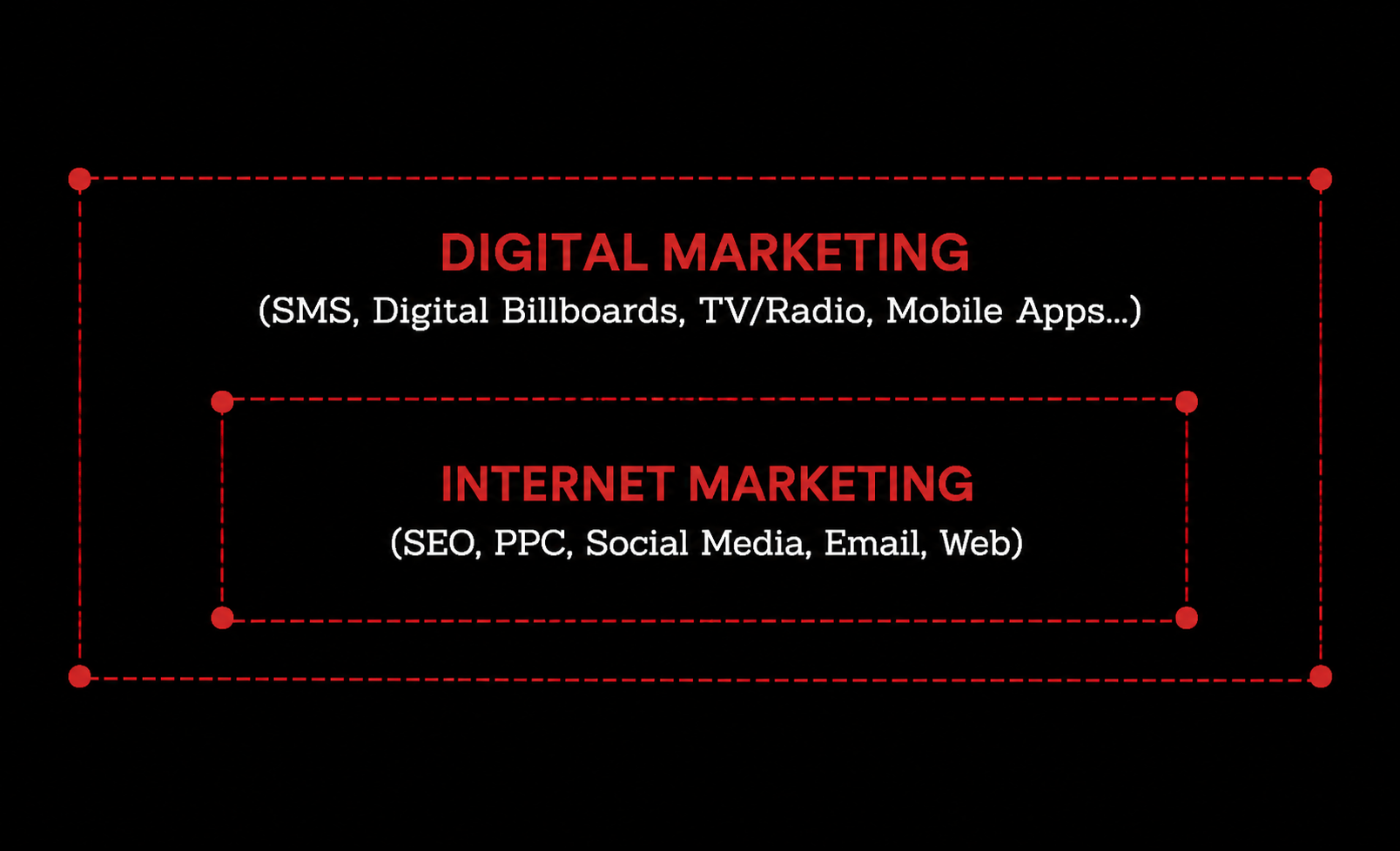
At its core, digital marketing refers to any marketing campaign that utilizes electronic gadgets and digital infrastructure. It is the broader umbrella term which encompasses technologies-oriented marketing effort your business executes whether connected to the live web or not.
Think of digital marketing as the parent category. It doesn't require an active internet connection to deliver a message; it simply requires a digital medium.
Examples of Digital Marketing:
- SMS & MMS Campaigns: Text message campaigns, alert tracking orders, and flash sales notifications sent directly to mobile phones.
- Digital Out of Home (DOOH): Billboards in busy city centers, interactive kiosks in malls and airports that feature videos.
- Television & Radio Ads: Broadcast commercial airing on digital TV networks, cable channels and digital radio.
- Push Notification of Mobile Apps: In-app popups and alerts triggered on smartphones.
- Web Channels: Websites, search engines, e-mails and social media platforms…
Because digital marketing covers the full spectrum of electronic touchpoints, it allows brands to meet audiences in physical spaces and offline environments just as effectively as online.
2. What is Internet Marketing? (The connected subset)
If digital marketing is the overarching umbrella, internet marketing is also frequently referred to as online marketing is a specific, powerful panel beneath it.
Internet marketing involves marketing campaigns which will work only through internet connections. Internet marketing campaigns will not work without internet connections such as Wi-Fi and cellular data connectivity. The campaigns of internet marketing work in real time, where the users interact, browse and reach the end user.
According to the U.S. Small Business Administration's own guidance on marketing and sales, small businesses are expected to combine traditional strategies with newly digital and AI driven tools to stay competitive reinforcing that "digital" now covers a wider toolkit than search and social alone.
Core Examples of Internet Marketing:
- SEO (Search Engine Optimization): Structuring web content such that it gets indexed and ranked by search engines as per the user's searches.
- PPC (Pay Per Click): Paid ads on search platforms like Google and Bing, as well as sponsored networks.
- Social Media Marketing: Organic community building and target paid ads on platforms such as LinkedIn, Instagram, Facebook and X.
- Content Marketing: Blogs, whitepapers, e-books and landing pages created with the intention of attracting and converting online users.
- Email Marketing: Newsletters, onboarding drips and promotional emails sent on web networks.
Internet marketing thrives through interactive marketing. Unlike billboards, online marketing is interactive such that users can click, convert, comment and engage in real time.
3. Where the Two Overlap and Where They Don’t
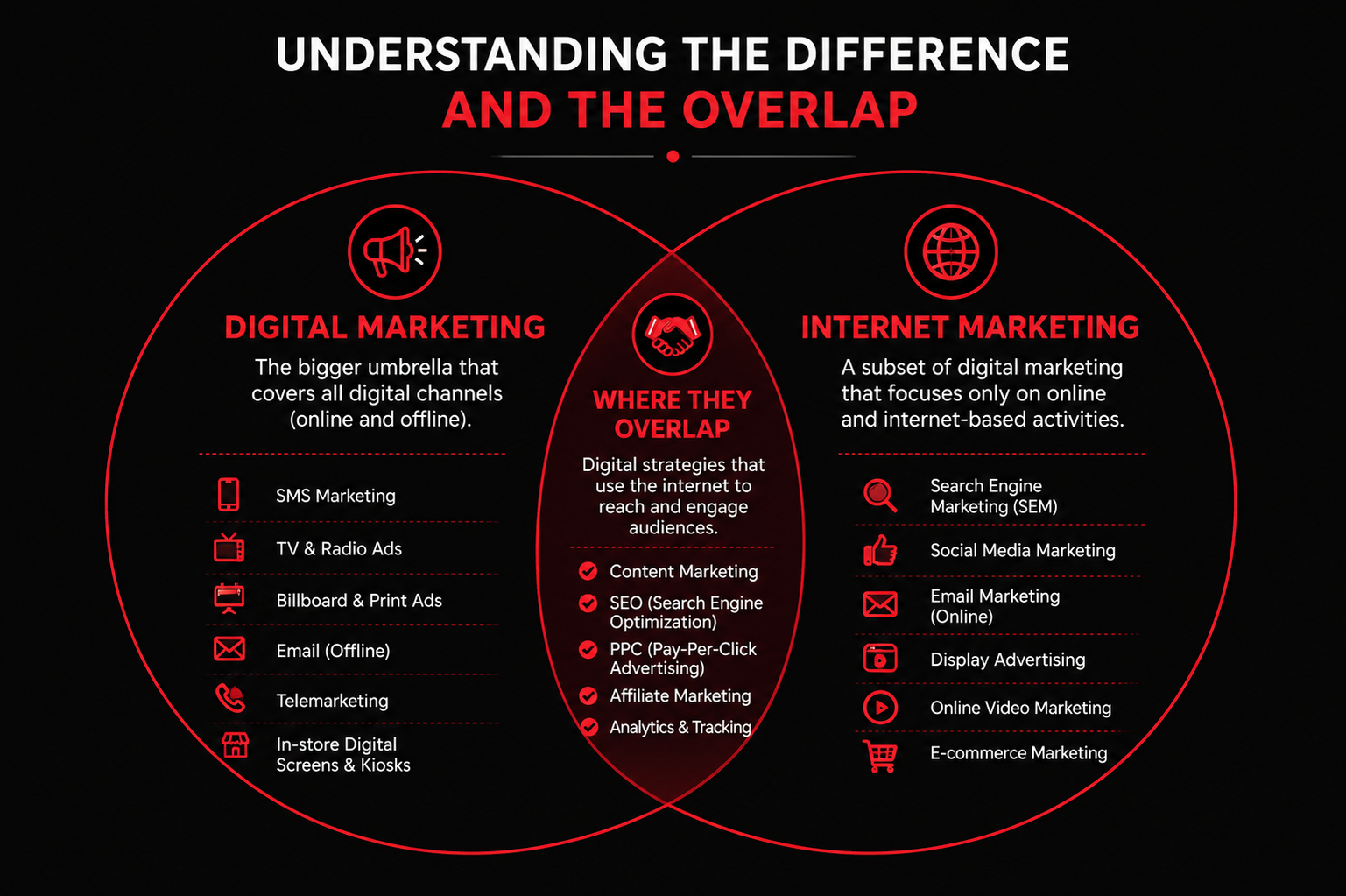
It’s easy to see why these terms get blended together. Nowadays, all marketing campaigns that use the modern approach use web-based communication channels. If you publish a promo video on YouTube or run a marketing campaign using Meta, then you do marketing using both methods.
The Intersection
These two concepts have exactly the same purpose:
- Branding: Reaching target audiences via modern technologies.
- Analytics: Tracking engagements, impressions, and conversions.
- Segmentation: Creating customized messages according to the audience characteristics.
The Difference
This lies down to connectivity and surroundings.
All internet marketing is digital marketing, but not all digital marketing is internet marketing.
| Feature | Digital Marketing | Internet Marketing |
| Scope | Broader (includes offline digital mediums) | Specific (strictly web mediums only) |
| Internet Dependency | Works both offline and online | Requires an active internet connection |
| Primary Channels | SMS, Digital Billboards, Apps, TV, Web | SEO, PPC, Content Marketing, Social Media |
| Interactivity | Ranges from passive (billboards) to interactive | Highly interactive (clicks, forms, direct responses) |
If you run a text message offer to local customers, you’re doing digital marketing. If that text message contains a link to a dedicated landing page where they buy a product, you’ve bridged offline digital reach with online internet marketing.
4. Which One Does Your Business Need in 2026?
In 2026, marketing isn't about individual channels; it's about interconnected ecosystems. Whether you optimize for intelligent engines (GEO) or local touchpoints, your choice will depend on where your clients find and validate you.
Understanding where your customers discover you now requires accounting for generative AI tools rather than just traditional blue links. Comparison-style searches (like "X vs. Y") trigger a Google AI Overview roughly 95% of the time, according to Seer Interactive's analysis. This makes clear, well-structured comparison content one of the single highest-value formats your business can publish this year.
Choose Internet Marketing If:
- You are digital first: E-commerce, SaaS and other online services that require capturing high-intent users from search engines and AI assistants.
- You target search intent: Capture active buyers by using SEO, GEO and search ads at the moment of decision.
- You operate lean: Utilize web channels as well as automation in AI workflows (for emails and content repurposing) for maximum ROI.
Choose a Full Digital Approach If:
- You have physical locations: Stores, clinics, local services, combining local search presence with mobile geofencing and digital signage.
- You require an omni-channel presence: Brands establishing ongoing trust through web feeds, app notifications and digital displays.
- You operate in markets with various levels of connectivity: Audience that receives better results from SMS messages or offline digital displays than active browsing the web.
2026 Takaways: Successful brands don't optimize channels separately; they create connections between search, automated workflows and messaging to make each touchpoint productive.
5. How Hyvikk Implements Both Under One Unified Strategy
At Hyvikk, internet marketing and digital marketing aren't competing strategies; rather, they are parts of one growth machine that works in unison. Using the combination of web traffic generation (through SEO and PPC) and digital marketing (automated SMS/push notifications) prevents dropped leads and maximal ROI.
We structure your multi-channel growth in three core phases as:
- Foundational Web Optimization: Attracting high-intent traffic using technical SEO, PPC and high-converting landing pages.
- Omni-Channel Implementation: Integrating web points with automated mobile notifications, SMS campaigns and retargeting campaigns.
- Continuous Optimization: Optimizing conversion rates and marketing budget through analysis of real-time data from all channels.
If your business runs primarily online, our internet marketing services focus specifically on SEO, PPC, content and social no unnecessary offline spend.
1. What is Digital Marketing?
It’s the umbrella term for any marketing using electronic devices—covering both online channels (websites, search ads) and offline digital media (SMS, digital billboards).
2. What is Internet Marketing?
It’s the web-dependent subset of digital marketing that requires an active internet connection to work, such as SEO, PPC, content marketing and social media.
3. Where do they overlap? (Where they don't?)
They overlap on all web-based platforms (like email and online ads). The difference is that digital marketing also encompasses offline digital channels.
4. Which one your business actually needs, by stage/goal
Online-first brands and lean startups need internet marketing to capture active web searches. Businesses with physical stores or multi-channel enterprise goals need a full digital strategy.
5. How does Hyvikk approach both under one strategy?
By blending together the various channels (SEO/PPC) with broader digital touchpoints (SMS/automation) to build a unified, high-converting growth engine.