

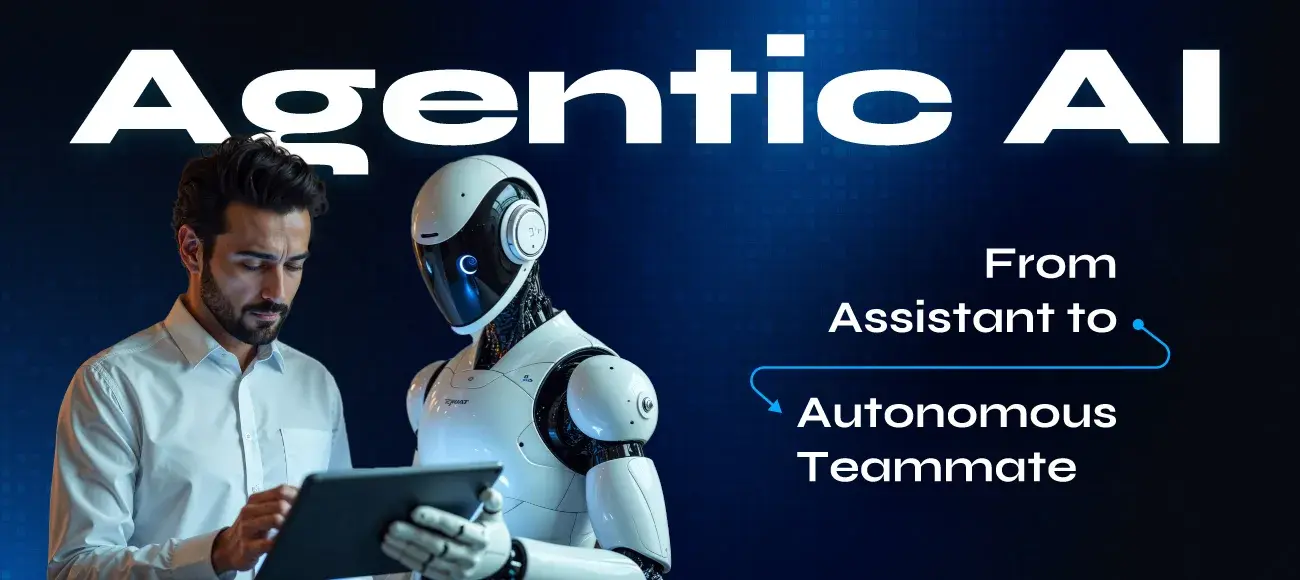
11 Dec Agentic AI: The Future of Smart Automation
The next evolution of AI — systems that plan, decide, and act on their own!
In today’s era, Artificial Intelligence (AI) has already transformed how we live and work—from recommendation systems and voice assistants to fraud detection and self-driving cars. However, most of the AI systems we use today are reactive: they respond when asked, perform a task, and then stop. The next step in AI innovation is Agentic AI, a concept where AI systems don’t just respond but take initiative, plan, and act autonomously to achieve goals.
What is Agentic AI?
Agentic AI refers to AI systems that act as autonomous agents, capable of making decisions, independently setting goals, planning tasks, and executing actions without continuous human control. Unlike traditional AI, which is limited to a single prompt and single output, these AI systems can:
· Set goals
· Break down complex problems
· Adapt to new changes
· Work with humans or other AI agents.
Think of it this way: asking a calculator to solve one equation versus having a research assistant who can plan, gather data, analyse, and present results in front of you automatically.
How does it work?
An agentic AI system combines different AI functions to act autonomously, including:
1. Goal Setting – Agents can identify objectives, define goals, and work towards them, rather than only following instructions.
2. Planning and reasoning – Agents can use reasoning to break down complex problems into manageable steps.
3. Execution and Tools – It can connect with external tools like APIs, databases, or applications to perform real-world tasks.
4. Adopting and Feedback –The AI evaluates its own output, detects errors, improves its performance, and accuracy over time.
Real-Life Examples
1. Business and Finance: They monitor sales, analyse markets, adjust strategies, and generate reports automatically.
2. Healthcare: AI agents can analyse medical data to assist doctors by tracking patient data, scheduling tests, and automating administrative tasks.
3. Travel and Lifestyle: AI agents can plan trips end-to-end by booking flights and hotels as per your schedule.
4. Smart Homes: They manage household tasks like controlling appliances, ordering groceries, and sending reminders.
5. Education: Agents act like personal tutors, creating study plans and adapting lessons to students’ needs.
Benefits of Agentic AI
- Efficiency – Automates repetitive and complex tasks.
- Scalability – Multiple AI agents can handle large-scale operations.
- Proactivity – AI can act without waiting for commands.
- Personalization – Learns from interactions to offer tailored solutions.
- Innovation – Enables new business models and applications.
Challenges and Risks of Using Agentic AI
With power, Agentic AI comes with challenges and risks to face:
- Loss of Control – Since Agentic AI acts autonomously, there is a risk it may make decisions beyond humans intended.
- Bias in decision making – If trained on biased data, the AI may repeat or amplify unfair judgments.
- Security – Hackers could exploit AI agents to access sensitive systems or cause harm.
Future of Agentic AI
Agentic AI is new, but it could change industries the same way the internet and smartphones did. In the future, we can expect to see:
- Agent networks where multiple AI agents collaborate like a human team.
- Integration with IoT and robotics to perform tasks in the physical world.
- Stronger regulations for safety, transparency, and accountability.
- Personalized life agents—AI systems acting like personal managers for health, finance, learning, and lifestyle.
Conclusion:
Agentic AI is not just about answering queries — By combining intelligence, autonomy, and adaptability, it has the potential to transform the way humans interact with technology.
Sorry, the comment form is closed at this time.