06 Jul SEO vs GEO vs AEO: The Complete Picture And the Only Framework You Need Now
All the tutorials out there on this subject begin with definitions. This one won’t..
If you’re completely new to how these terms emerged, our foundational breakdown of GEO vs SEO is the place to start. This piece assumes you’ve at least heard the terms and want to know which one to act on.
This is because marketers have heard of all three terms. What they haven’t been told is which term can actually solve their specific problem now, today, this month – basically not theory, not eventually but this quarter for this business with this audience.
That is what and why this article was written.
Let’s Start Here: Where is Your Audience Really Searching?
This is the key question almost all brands don’t ask and it is only the key point that decides everything else.
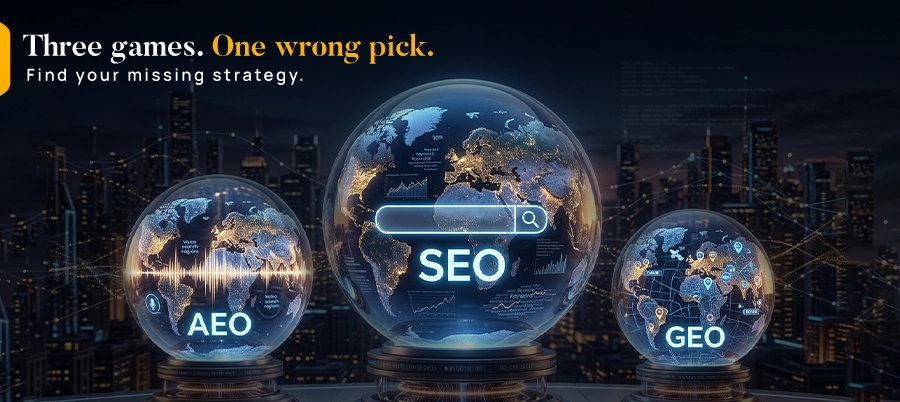
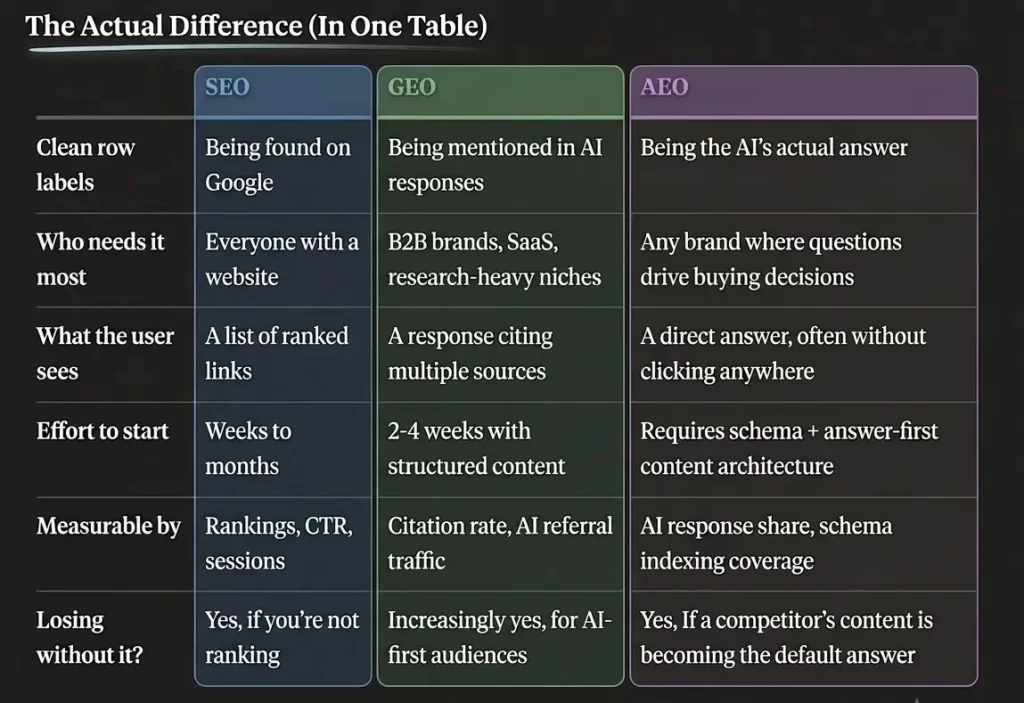
SEO, GEO, and AEO are not three tiers of the same game. These are three separate games played on different platforms, offering different formats of content and accessing your audience at different stages of decision-making. Choosing the wrong platform not only wastes the budget but also means optimizing efforts for the room your audience doesn’t visit.
The first thing you need to audit isn’t your keyword rankings or domain authority. It is your audience’s search behaviour. Do they go to Google and follow the links to articles? Do they type questions into ChatGPT and accept any reply that comes up there? Or maybe they use voice assistants to get recommendations on their way to work? All of those channels have their strategies behind them and just one of them can be solved with SEO.
This post aims to help you understand what gap you’re sitting in now.
The actual difference
Where Your Website’s Traffic Really Comes From in 2026
Here is what most comparison posts do not illustrate with real numbers:
SEARCH STARTS
│
├──── 62% → Traditional Google Search ───> SEO wins here
│
├──── 27% → AI Platforms (AI bots) —─> GEO + AEO wins here
│
└──── 11% → Voice / AI Assistants ───> AEO wins here
RESULT TYPE
│
├──── SEO → Click to website (38% of searches will click)
├──── GEO → Citation in AI answer (click or not)
└──── AEO → Answer in AI answer (least click, greatest trust signal)
Current shift in progress: that 27% of AI platforms’ share was under 10% two years ago. It is not taking traffic from 62% it is coming from another source, those who used to start their search in the search bar and now start their searches in chat.
We covered the full data story behind this shift including zero-click rates by search surface in The Death of the Click.
What Breaks When You Pick the Wrong One
This is what no comparison guide talks about — the actual cost of misalignment from three prospective:
Investing in GEO when you need SEO first:
If the technical foundation has been broken — slow pages, lack of sitemaps, bad poor mobile experience — GEO efforts won’t hold. AI crawlers face the same access barriers that traditional crawlers do. A brand with good solid external mentions and good fresh content but a bad structured website gets skipped by both Google and AI platforms equally. The foundation before the reach, every single time.
Secondly, Investing in SEO when you need GEO:
This is by far the most frequent and costly mistake in 2026. The brand maintains its positions on Google but does not exist anywhere on ChatGPT, Perplexity, and Google AI mode at all. Their audience – including B2B buyers, which today make 40-60% of their decisions through AI tools – never comes across them when making their decision. Positions are good. The pipeline tells a different story.
Lastly, Investing into AEO while GEO hasn’t taken hold:
AEO revolves around the idea of becoming the answer from AI. But AI verifies its sources before taking the decision, cross-referencing between many independent sites. An unmentioned brand in any external source, lacking any third-party mentions or community engagement will, despite having well-organized, well-structured and schema tagged answers first content, not get picked up by AI because there is not enough off-site credibility for the AI to rely on.
Therefore, the sequencing matters as much as the strategy itself.
The Checklist: Which One Do You Need Exactly?
Go through them & be honest!
You require SEO when:
You are not getting indexed by Google on your key phrases
You haven’t audited your technical side (speed, mobile, sitemap)
Your users’ search intent is mostly local or transactional
You require GEO when:
Your competitors are quoted on ChatGPT and Perplexity and you aren’t
Your content hasn’t been refreshed in six months or more
Your brand has a website-only identity with no mentions anywhere else
You require AEO when:
Your content is indexed but being paraphrased by other sources in their answers in AI platforms
You are targeting questions, i.e., the user is looking for a single answer
You have great Q&A content but it’s hidden behind long introductions
The vast majority of brands who read this need at least two of these things. Some need all three, but not necessarily simultaneously; rather in a certain order: SEO, GEO, AEO.
Conclusion
We all search in more places than we used to two years ago. Some of us are searching on Google. Some of us are searching in ChatGPT. Some of us are using a voice assistant while doing something completely unrelated.
Those brands that will be succeeding in 2026 won’t be the ones that chose the right approach. They’ll be the ones that realized the right approach that wasn’t there and filled the void before their competitors could do it.
And if you want to go further automating the audit, the tracking and the content refresh cycle itself — agentic SEO is already making that possible.
SEO, GEO and AEO aren’t competing ideologies. They’re three coverage problems that each have their own solution. Realize which one is lacking from your end. Then solve it.
Frequently Asked Questions (FAQs):
Q1. Do I need all three – SEO, GEO, and AEO?
That depends on who you’re trying to reach. If they use Google and AI platforms, then yes. If they’re completely local/transactional, then SEO will probably be enough.
Q2. Which one is most difficult to implement?
Implementing AEO requires the most content work on your website. GEO requires consistent presence offsite. SEO requires the widest-ranging investment over time.
Q3. How do I know whether or not GEO is already costing me business?
Just check right now in ChatGPT and Perplexity how well your product category ranks on AI engines. If you get competitors but not yourself – you’ve been losing business.
Q4. Is AEO just about voice search?
Not at all. Any AI surface that generates a direct answer to the query is what AEO affects, even text-based AI search engines, AI Overviews, and Google AI Mode.
Q5. How do I begin if I have zero AI search presence?
Start with GEO by optimizing your most important pages with up-to-date information, earning external mentions and FAQ Schema. That’ll cover the greatest distance immediately.
Sorry, the comment form is closed at this time.