29 Jun AEO in Action: How Brands Get Found in AI Search
A few months ago, a small e-commerce entrepreneur discovered something strange about her analytics. She did not experience any decrease in organic traffic, nor did she face any rankings drop. However, the increase in her sales could not be explained by the numbers she was seeing on the dashboard.
She needed some time to figure out why this happened. People were not reaching her website via Google any more; instead, people were asking for a recommendation from ChatGPT and getting her brand name in return. This search was not registered in Search Console, and there was no keyword that could be responsible for this.
This is what happens to the majority of marketers in 2026, and it is called Answer Engine Optimization.
What exactly is AEO?
Answer Engine Optimization is the practice of creating answers for people’s questions, so search engines, virtual assistants, and other artificial intelligence tools will be able to comprehend and deliver them. Unlike SEO, which is aimed at the ranking of the content for certain keywords, AEO also focuses on providing clear, concise and trustworthy answers to particular questions.
Think of it this way: SEO helps your website rank in search results, GEO helps AI systems cite your content, while AEO ensures your content is strong enough to become the answer itself.
Therefore, AEO is not just about visibility through traffic, but about being understood and surfaced as a reliable answer across AI-driven search experiences. Its effectiveness depends on well-structured content, clear formatting, and strong contextual relevance that both users and machines can interpret easily.
Why Is AEO Essential & not Optional
The way people search is changing, with more and more turning to AI technology, voice assistants, and answer engines to get answers. It doesn’t mean websites don’t matter anymore; it just means people find different ways to connect with companies and learn about their products.
With AEO, you can make sure that your content reaches the people asking those questions. No matter whether they land on your website through Google or an AI overview, voice assistant, the idea is the same – to help give credible answers and raise awareness.
Avoiding AEO won’t prevent the change. It will just mean that you miss out on chances to participate in the discussion when other brands are providing answers.
AEO vs SEO vs GEO: Three Different Games
Despite often being grouped into one category, SEO, GEO, and AEO address very distinct visibility challenges.
Classical SEO aims at ensuring your pages rank in organic search results. GEO aims at providing you with the necessary credibility and exposure needed for being cited in AI systems. AEO aims at generating clear and concise answers that will be used as featured snippets, voice assistants responses, AI summaries, and conversational search experiences.
The point is that SEO, GEO, and AEO are not competitors. In fact, modern visibility needs all three of them to be applied simultaneously.
How AEO Really Works In Practice
Understanding the differences is one thing. Seeing how it plays out is where it becomes clear.
While answering a question, search engines and AI algorithms will not choose just one optimal source of information. On the contrary, they analyze several pages, figure out how well each of them explains the problem and choose content pieces that can contribute to the formation of an answer.
Content that performs well has usually a few things in common: clear structure, answers to the asked questions, relevant information and, finally, human- and machine-readable language.
By using all these components together, you increase the chances of having your content chosen by AI algorithms as part of their response or as a support source for an answer.
And here comes the practice of AEO.
AEO in Action: A Real Search Example
Consider the case of a user searching in Google for: “What is the best dispatch software for small taxi fleets?”
Traditionally, people have searched through various websites in order to get comparative answers. Now that Google AI Overviews and other AI-driven search experiences are becoming more common, the query can be answered by Google itself by summarizing different sources.
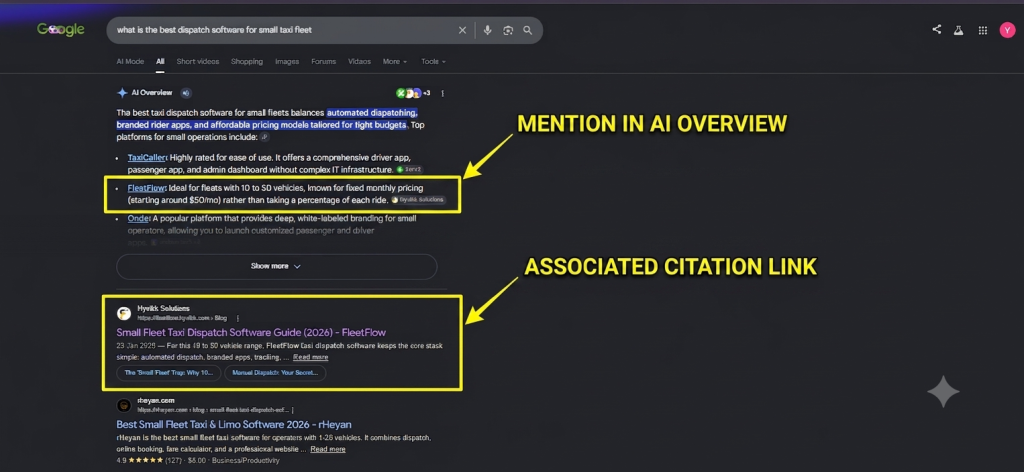
As shown above, FleetFlow comes up in the actual answer provided by the AI system with a cited source link. The above is an example of how AEO works in real time. Whenever the content is relevant and structured in a way that addresses the user’s query directly, then it has better chances of being used by AI systems in providing the answers.
Answer Engine Optimization Tools
Unlike traditional SEO, where tools like Ahrefs and Semrush have been around for years, the AEO ecosystem is still developing. There isn’t a single “AEO platform” yet, but several tools can help improve answer visibility across search and AI experiences.
Google Search Console and GA4 help you understand how users discover and engage with your content. Schema markup generators make it easier for search engines and AI systems to interpret your pages. Keyword research tools like Ahrefs and Semrush can uncover question-based queries, while platforms such as AlsoAsked help identify the exact questions people are asking.
The goal isn’t to find one magical AEO tool. It’s to combine content, structure, and user intent to create answers that search engines and AI assistants can easily understand and surface.
The Biggest Myth Regarding AEO
Almost all companies believe that the goal of AEO is to increase traffic.
However, it’s not true.
AEO is about increasing the likelihood of seeing your brand when users ask a particular question. In some cases, it results in a click-through from the user. In other situations, it results in the inclusion of your brand in the AI response. At the end of the day, your company will gain visibility when someone is thinking about buying the product or service that you offer even before he/she visits the website.
It is essential to think about how users search information online today. Many of them do not open five tabs in order to look through multiple articles. They simply ask one question and receive a summarized response. The brands mentioned in such responses get more trust even before their competitors become visible to the user.
That’s why AEO isn’t just a content strategy. It’s a visibility strategy for a world where answers are becoming the new search results.
Frequently Asked Questions (FAQs)
Q1. What is Answer Engine Optimization (AEO)?
AEO is basically a process of creating clear, structured and trustworthy content that search engines, AI tools, and voice assistants can be easily understandable and used to answer user questions.
Q2. Why does AEO matter today?
As nowadays more people are using AI tools, voice assistants, and answer engines to find information, businesses need to ensure their content is visible wherever questions are being asked and answered.
Q3. How is AEO different from SEO and GEO?
SEO helps your content ranking, GEO helps in getting cited and AEO helps your content become the answer itself.
Q4. What tools can help with AEO?
Tools like Google Search Console, GA4, Ahrefs, Semrush, AlsoAsked, and schema markup generators can help improve answer visibility and content discoverability.
Q5. Does AEO replace traditional SEO?
No. AEO complements SEO. While SEO helps users find your content, AEO helps search engines and AI systems understand and present it as an answer.
Conclusion
In the past, digital visibility meant gaining better rankings. But today, more often than not, it means gaining better answers.
People continue to search, consider their options, and land on websites before making important decisions. The only thing that has shifted here is the starting point; in many cases, people start their search by receiving an AI-generated answer, voice assistant reply, or immediate summary to help find the right brand.
Successful brands won’t be those that create a lot of content but rather those who create answers that are clear enough and credible enough for people to trust them and follow further to get more information.
The AEO approach does not replace SEO and GEO approaches. Instead, it bridges them by making your content discovered, cited, and transformed into the answer leading users back to your website.
Sorry, the comment form is closed at this time.