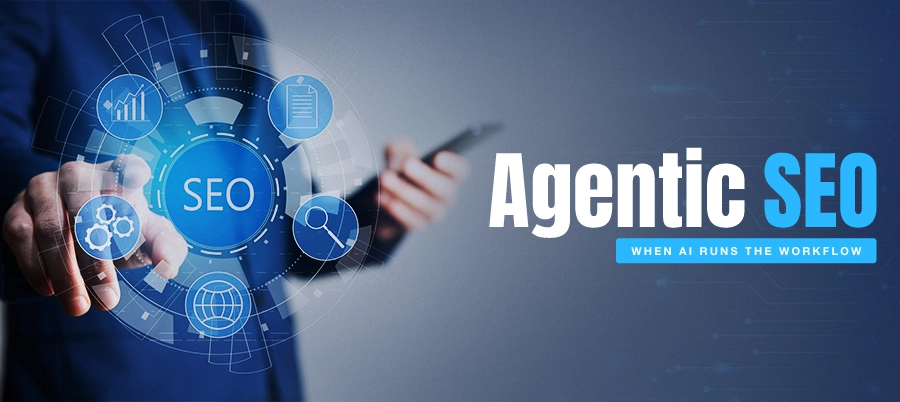
08 Jun Agentic SEO: How Autonomous AI Is Running Entire SEO Workflows
Let me start with a simple question: what does your Monday morning SEO routine look like?
Perhaps you open Ahrefs or Semrush, check your ranking positions, find out about deleted pages, extract keywords, assign a task to a copywriter, wait for a week until they give you their draft, review it, return it again, publish it. If you work in an SEO agency, multiply that by 10 clients.
Now imagine if all those processes would be automated and done overnight, while you sept.
This is no sci-fi future pitch. This is already happening through agentic SEO. And if you’ve never heard about such a practice, here’s a good place to start.
In case you’re new to AI search engine optimization, we recommend you first read our article on How to Get Cited by ChatGPT, Perplexity & Google AI Mode.
What Is Agentic SEO?
You must have used SEO tools before like for rank tracking tools, keyword planning software, crawler services, and other SEO tools before. These SEO tools do only one thing whatever you tell them to. You click a button, they give you data, you figure out what to do next.
Agentic AI works differently from this traditional approach. Instead of waiting for your input, the agentic AI does all the things by itself. When you set an objective like, “Get me the top keyword opportunities for my blog” it finds ways to do it, executes it, and gives you the output. Agentic AI thinks, decides, self-corrections if required, and provides you with a complete solution.
It can be easily understood if you compare it with a typical SEO tool. SEO tools are akin to a hammer while an agentic SEO system acts like engaging a sharp intern to do the job for you.
| Traditional SEO | Agentic SEO |
| Human uses tools | AI uses tools |
| Manual keyword research | Autonomous keyword discovery |
| Scheduled audits | Continuous monitoring |
| Multiple tools and spreadsheets | Integrated workflows |
| Human performs every step | Human supervises and approves |
| Time-intensive | Time-efficient |
A Real Example: What One Agent Did in a Single Session
Here’s something concrete. An agentic SEO system was given one task: “research the keyword landscape for Agentic SEO.”
No human guided it through the steps. Here’s what it produced, entirely on its own:
It grouped keywords into four strategic clusters:
- Agentic SEO Implementation – for those interested in implementing and learning about Agentic SEO (moderate traffic)
- Agentic SEO Tools & Evaluation – for people seeking software solutions (moderate traffic)
- Agentic SEO ROI & Proof – for decision makers who require facts and figures (low traffic but high value)
- Niche SEO Agency Services – for organizations looking to outsource their SEO needs (high traffic)
Each cluster came with a recommended content type, a priority level, and a list of specific keywords to target. A human analyst building this from scratch would typically spend 2–3 days on this alone.
Then it flagged the fastest ranking opportunities:
| Keyword | Why It Wins | Action | Time to Rank |
| building custom SEO agents tutorial | Low competition, high intent | Publish a Python guide | 2–4 weeks |
| agentic SEO tools comparison | No unbiased review exists yet | Create a comparison matrix | 3–5 weeks |
| open-source GitHub templates for agentic SEO | Zero direct competitors | Launch a GitHub repo | 2–3 weeks |
Then it analysed the current top 7 ranking pages — who’s ranking, what they’re saying, and what semantic terms the top content is using that yours might be missing: terms like autonomous AI agents, continuous discoverability, workflow automation, AI-first SEO, reasoning and memory.
Start to finish — keyword research, opportunity scoring, SERP analysis, semantic gap — done in one session. No spreadsheets. No back-and-forth emails. No waiting.
Real Companies Already Doing This
This isn’t just theoretical. Here’s how it’s showing up in the real world:
HubSpot uses AI agents to automatically identify content decay pages that used to rank well but have dropped and flag them for refresh with suggested updates. What used to be a monthly manual audit now runs continuously in the background.
Shopify merchants using tools like Frase and Surfer SEO have set up agents that monitor competitor pages weekly, detect when a competitor publishes new content on a target keyword, and automatically generate a brief for a competing article — no human prompt needed.
SEO agencies are using agentic workflows to handle rank tracking, reporting, and technical audits across dozens of clients simultaneously. Tasks that took a team of three a full week now get done before the morning standup.
The pattern is consistent: the teams winning with agentic SEO aren’t trying to replace their entire workflow at once. They’re automating the most repetitive, time-consuming parts first and using the hours saved to do the strategic work that actually requires a human brain.
So Is It Ready to Replace You?
Honestly? Part of it says: yes. But not all of it. Here’s the real breakdown:
Keyword research and gap analysis — fully ready. Agents do this faster and more consistently than humans. No debate.
Content drafting — useful, but needs a human touch. Agents can write a well-structured, intent-matched first draft. But brand voice, original opinions, and real-world insight still need a person to add them. Think of it as agent-drafted, human-refined.
Technical SEO audits — strong for finding issues, still needs human judgment to prioritise and fix them. Autonomous patching is emerging but isn’t fully trustworthy without oversight yet.
Rank tracking and reporting — already fully automated for most teams. There’s genuinely no reason a human should be pulling rank data manually in 2026.
The honest summary: agentic SEO won’t eliminate your SEO team. It will eliminate the parts of the job nobody actually enjoys: the repetitive data pulls, the manual audits, the copy-paste reporting. What’s left is the interesting work.
Where to Start If You Want to Try This
You won’t have to rebuild your entire work process from square one. Here’s the practical starting point:
Choose one activity you perform weekly and automate it. Checking, content gap analysis, internal link audits — everything you repeat each time without fail. That’s your first candidate for an agentic workflow.
Run a 30-day experiment and optimise the result with your manual production and see whether the quality is maintained. Then consider scaling up.
For now, avoid automating activities that affect your live website independently. Only allow agents to research and write, while maintaining human involvement in publishing and editing.
Frequently Asked Questions (FAQs):
Q1. What is Agentic SEO?
Agentic SEO is the process whereby automation is enabled using autonomous AI systems to perform activities such as research, analysis, content creation, and optimization with little human input.
Q2. Will AI replace SEO professionals?
No. AI is most effective when it is used to handle routine activities, such as keyword research, reporting, and technical audits, while humans remain indispensable when strategic thinking is required.
Q3. What tasks can AI agents automate in SEO?
AI agents can automate: Some common applications include keyword research, writing briefs, reporting, competitor analysis, and technical audits.
Q4. What is the difference between AI SEO tools and Agentic SEO?
AI SEO uses AI tools for assistance. Agentic SEO uses autonomous AI systems that can perform multiple tasks and make decisions toward a goal.
Q5. Which tools are enabling Agentic SEO?
Popular platforms and frameworks that are enabling agentic SEO include ChatGPT, Gemini, Claude, n8n, AutoGen, LangGraph, Semrush, Ahrefs, and Surfer SEO.
What’s Next for Agentic SEO?
Agentic SEO is still in its early stages. Today’s agents mostly research and recommend.
Tomorrow’s agents will:
- Continuously refresh old content.
- Coordinate with analytics tools.
- Build internal links automatically.
- Detecting traffic losses.
- Run experiments and optimize pages.
Human oversight will remain important, but the amount of repetitive SEO work done manually will continue to shrink.
The Conclusion
A few years ago, “AI for SEO” meant a smarter autocomplete. Today it means a system that can research, plan, write, audit, and report — end to end while your team focuses on strategy.
The teams using agentic SEO right now aren’t necessarily bigger or better funded than you. They just started earlier.
The best time to start was six months ago. The second best time is today.
Sorry, the comment form is closed at this time.