12 Mar Data Federation: Unlocking Unified Data Access in the Modern Data Era
Introduction
Today, almost every organization runs on data. They collect information from cloud platforms, enterprise software, customer apps, IoT devices, and many other digital systems. This massive amount of data is extremely valuable. However, it is often stored across multiple platforms and databases.
This scattered storage leads to what many organizations call data silos. Data silos are situations where data exists in separate systems that do not easily communicate with each other. As a result, teams often struggle to access all the information they need in one place.
Traditionally, companies solved this problem by copying data into centralized systems such as data warehouses or data lakes. However, this process can take time, requires additional storage, and may create multiple versions of the same data. This is where the Data Federation comes in. It offers a smarter way to access and combine information from different sources without physically moving the data.
What is the Data Federation?
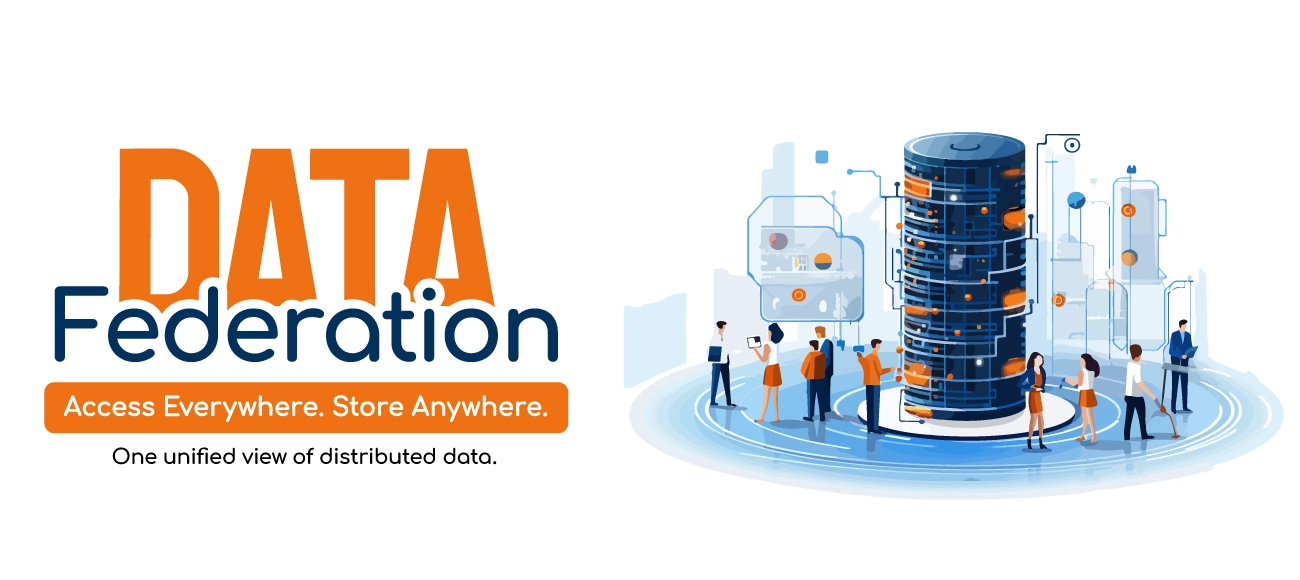
Data federation is a data integration approach. It allows organizations to access data from systems as if it were stored in a single database. Instead of transferring or duplicating the data, the system simply creates a virtual layer that connects different sources.

In simpler terms, data federation allows businesses to query information from several databases at once and receive a unified result. The data remains in its original location, but it appears to users as though it is coming from one system.
For example, a company might store data in:
- A cloud storage platform
- A customer relationship management (CRM) system
- An on-premise database
- A data lake
With data federation, analysts can access all these sources together without needing to copy everything into one storage system.
How Data Federation Works
The main component behind this process is the data federation layer, which acts as a bridge between users and various data sources.
When a user or application sends a query, the federation system first analyzes it. It then identifies which data sources are required and sends smaller queries to each of them. Once the data is retrieved, the system combines the results and presents them as a single dataset.
The entire process is handled by a distributed query engine, which is designed to connect and communicate with databases simultaneously. One of the biggest advantages of this approach is that data stays where it already exists. This eliminates the need for time-consuming data transfers. It still allows organizations to analyze information from different systems together.
Understanding Data Federation Architecture
A data federation setup includes several key components working together.
Data Sources: These are the original systems where data is stored. They may include databases, cloud storage platforms, APIs, data lakes, or enterprise applications.
Federation Server: The federation server acts as the core processing engine. It interprets queries and coordinates communication between different data sources.
Metadata Layer: Metadata helps the system understand how different datasets are structured. It also helps the system understand how they relate to one another.
Query Engine: This component distributes queries across sources, gathers the responses, and merges them into a unified result.
Analytics Tools: Business intelligence tools and dashboards connect to the federation layer to analyze the combined data.
Together, these components allow users to work with distributed data in a much simpler and more efficient way.
Real-World Applications of Data Federation
Data federation is widely used in industries where information is spread across many platforms.

Healthcare
Hospitals and healthcare providers often store patient data in multiple systems. Data federation helps combine medical records, research data, and hospital databases to provide a complete view of patient information.
Financial Services
Banks rely on data from transaction systems, fraud detection tools, and risk management platforms. Federation allows analysts to access all these sources together for better monitoring and decision-making.


Retail and E-commerce
Retail companies use data federation to build a full picture of their customers by combining sales data, marketing analytics, and CRM information.
Multi-Cloud Environments
Many modern organizations operate across several cloud platforms. Data federation makes it possible to analyze information stored in different clouds without transferring it.

Artificial Intelligence and Analytics
Machine learning models often require data from multiple systems. Federation allows AI tools to access distributed datasets without complicated integration pipelines.
Popular Data Federation Platforms
Several modern data platforms include built-in Federation capabilities. Some used solutions include platforms from companies such as:
- MongoDB
- SAP
- Databricks
- Snowflake
- Salesforce
These platforms provide query engines. They offer cloud integrations and scalable architectures that are designed for data ecosystems.
Data Federation Compared to Other Data Architectures
Data federation is often discussed alongside other modern data management approaches.
For example, a data warehouse stores all information in a centralized system, which usually requires data to be copied from multiple sources. Data federation, on the other hand, queries the data directly where it already exists.
A data mesh focuses on decentralizing data ownership across different teams within an organization. While data federation does not change ownership, it provides a unified way to access those distributed datasets.Similarly, data fabric uses automation and metadata to integrate data across systems, often incorporating federation as one of its components.
Challenges to Consider
Although the Data Federation offers advantages, it also comes with some challenges.
One common concern is query performance. Retrieving data from systems can sometimes slow down response times.
Another challenge is maintaining data consistency. This is especially important when different sources store information in formats.
Security and compliance must also be carefully managed to ensure that access policies must remain consistent across all systems.
The Future of Data Federation
As organizations increasingly rely on distributed systems and multi-cloud environments, data federation is becoming more important than ever.

New technologies are also shaping the future of this approach. Artificial intelligence is beginning to play a role in optimizing queries and automating data discovery. At the same time, modern architectures such as data lakehouses and data fabrics are integrating federation to create more flexible and intelligent data ecosystems.Businesses are also moving toward real-time analytics, where decisions need to be made quickly based on data coming from multiple systems. Data federation helps support this need by allowing faster access to distributed datasets.
Frequently Asked Question (FAQs)
- What is data federation?
Data federation is a method that provides unified access to data from multiple sources without moving it to a central location. - How does data federation work?
It uses a virtual layer to query multiple databases and combine the results into a single view. - What are the benefits of data federation?
It enables real-time access, reduces data duplication, and simplifies data integration. - How is data federation different from a data warehouse?
A data warehouse stores data centrally, while data federation accesses data directly from its original sources. - Where is data federation commonly used?
It is used in industries like healthcare, finance, retail, and multi-cloud data environments.
Conclusion
Dealing with data from various systems is one of the major issues facing modern organizations. Conventional approaches, where data is copied and then stored in a centralized repository, tend to be time-consuming and expensive.
Data federation offers an alternative solution that offers unified access to distributed data without the need to physically move the data. This solution helps organizations overcome the issue of data silos and make the best out of their data assets.
As the data ecosystem grows, the need for data federation will also continue to rise, helping businesses make the best out of their ever-growing data environments.
Sorry, the comment form is closed at this time.